Showing posts with label San Francisco Bay. Show all posts

Tuesday, August 6, 2013

Digging for Gold at the Library: Jane Proctor letter, HDC 1043

(by Gina Bardi, Reference Librarian)

Most of what I write about for this blog are fun items- little gems with interesting pictures or something just plain delightful I’ve stumbled across.  This though is about something I found in our collection which was so sincere and heart wrenching that even though it’s a departure from my usual pieces, I had to share it with you.

The document is a letter in our archives, Historical Document Collection 1043.  It’s a letter written by a woman named Jane Proctor who was a nurse at the Army Hospital at the Presidio.  It was written late in the night of February 22nd, 1901. Ms. Proctor was unable to sleep due to the deep and overwhelming grief she felt over the wreck the day before of The City of Rio de Janeiro. The City of Rio de Janeiro was a Trans-Pacific steamship operating between San Francisco and Asia. On the 21st of February 1901, she was headed into San Francisco Bay when she hit a reef.  She sank quickly; her holds were completely flooded.  130 people died that night; many of the bodies washing ashore the next day. Ms. Proctor describes this horrific scene to unnamed friends back home in harrowing terms.

The full letter is below.  It has been transcribed from the original.  The full collection includes a few more items about Ms. Proctor including a diary entry.  A finding aid for the collection can be found here:

transcribed letter, typescript, page 1

transcribed letter, typescript, page 2


Citation:
Proctor, Jane.  Letter in regards to the City of Rio de Janeiro.Jane Proctor Collection. HDC 1043.

Museum Archives and Manuscript Collections, San Francisco Maritime National Historical Park.

Tuesday, May 28, 2013

Photo Archives Spotlight: Definitive Men of the San Francisco Bay

(M. Crawford, Processing Archivist)
The waters of the San Francisco Bay have made many sea captains; men and women have begun their careers traversing the Bay, up and down the coast, and up into the rivers and deltas inland. Some of the recently processed collections in the Historic Documents Department tell the stories of some of these men--at the helm of tugboats, Monterey clippers, and sailboats. Although the collections may not seem to have much in common upon first glance, when you take a closer look at the lives they document, you will find that these men lived by the sea, made a living from the sea, and in the case of one captain, died at sea.


A web link to the Jack Ehrhorn collection of Stone Boat Yard photographs guide with more information about this collection including content, arrangement, histories and access.
Click for Collection Guide
Jack Ehrhorn collection of Stone Boat Yard photographs, circa 1885-2005. P05-081 (SAFR 23147)

Original black-and-white photographic print, 8 x 10 inches. Close-up of Jack Ehrhorn taken from a group photograph. He is standing next to an unidentified wooden-hulled boat under construction (likely St. Francis V (built 1973; sloop: yacht: 6 meter)). His right arm is up on the vessel; he is wearing white and a dark skully stocking cap. He is smiling, facing the camera. The photograph was taken at Stone Boat Yard, Alameda, California, circa 1973.
Decorated U.S. Army Platoon Sergeant, Jack Ehrhorn, was
entrusted with the photographs and textual materials from
the Stone Boat Yard. (P05-081, Ser.7.3, File 1, Item 923) 
Jack Ehrhorn was a life-long yachtsman, master shipwright, designer, draftsman and operations foreman. He started working for Lester Stone at the W.F. Stone & Son boatyard in 1941, where he helped build minesweepers for WWII. The Stone Boat Yard was a San Francisco Bay Area boat building company that was located in Alameda, California, from 1971-2004. The business had three previous names, and has been in four other locations in the San Francisco Bay Area since its establishment in San Francisco by W.I. Stone in 1853. It was run by three generations of Stones from 1853 until 1970 (W.I. Stone, W.F. Stone, and Lester Stone). It was one of the oldest and longest running businesses on the Pacific Coast and its boats and designs were very influential in Pacific Coast maritime history.

Black-and-white photographic print, 8 x 10 inches. The hull of St. Francis V (built 1973; sloop: yacht: 6 meter) is seen under construction, propped on blocks in a boat shop at Stone Boat Yard, Alameda, California, circa 1972-1973. View off port bow, three men are standing off port quarter with their backs to the camera. One of the men is wearing white overalls, which was characteristic of Jack Ehrhorn. Eight strips of planking are stem to stern over the ribs of the frame; planks are extending above the hull as well.
Ehrhorn helped build fast boats that won races, whether it was
his Yankee One Design  Flame, or the 6 Meter St. Francis V,
seen here in 1972. (P05-081, Ser. 6, File 5, Item 379)
One of Stone Boat Yard's specialties was producing first class yachts--the fastest on the bay some say. Ehrhorn worked on the constructing many of these beauties. In 1949, Lester even gave him a corner to build a yacht for himself, a Starling Burgess Yankee One Design, Number 34. Even in the 1970s, he was working on a 6 Metre St. Francis V designed by Gary Mull that won the 1973 World Cup in Seattle. Ehrhorn came to be the custodian of documents, photographs, photo albums and marine architecture drawings from the boat yard, all of which his estate donated to San Francisco Maritime National Historical Park in 2005. In this collection, there are over nine hundred photographs depicting vessels being built from start to finish, the details of construction, the tools and shop that they were built in, and the people that crafted these vessels. Combined with his collection of Stone Boat Yard records and marine architectural drawings (SAFR 21341, HDC 1288), we are able to see some of these boats come alive from their original drawings to yachts under sail.

A web link to the Captain Curt Hasenpusch photograph collection guide with more information about this collection including content, arrangement, histories and access.
Click for Collection Guide
Original black-and-white photographic print, 3.5 x 5.75 inches. Close-up of Vici Hasenpusch (left) standing on board an unidentified vessel, eating a cookie. Her forehead is bandaged after falling off a horse at Golden Gate Park. Her father, Captain Curt Hasenpusch stands to her left, with a plate in his hands. There is an unidentified woman in the background. What appears to be the Golden Gate Bridge is visible in the background. The occasion for being onboard was a picnic for crew and families. 1951-04-22
Domestic life was not
limited to land. The
captain and daughter,
Vici, on the bay.
P07-005 Ser. 4 File 3
Item 211.
Captain Curt Hasenpusch photograph collection, circa 1900-1960s. P07-005 (SAFR 23352)

Captain Curt August Hasenpusch (1910-1962), a first generation San Franciscan, was a boatman on the San Francisco Bay from the early 1930s until his death. His employers included Anderson's Shipyard and Crowley's Red Stack tugs, both eminent companies in Bay Area maritime history. He worked on everything from the pilot boat California to the tugboats Crowley No. 23 and Frank G. White during his career. Born in San Francisco on March 12, 1910, he was the second son of German immigrants who arrived just before the Great Earthquake and Fire. He was a collector of maritime photographs and memorabilia, as well as a model boat builder, one of which, the 1893 pilot boat Gracie S (SAFR 22765) is in our museum collection.

Black-and-white photographic print, 3.5 x 4.25 inches. Looking fore to aft along the deck of one tug, the photograph is of another tugboat alongside a listing vessel that has smoke rolling off the starboard deck. The San Francisco-Oakland Bay Bridge is in the background. Circa 1940s-1950s
Hasenpusch spent his life working the Bay
with many photos taken from those decks.
(P05-007, Ser.1.1, File 1, Item 52) 


His collection consists of mostly photographic prints, some of which hung in his family's home. Within the boxes, folders, and envelopes you will find photographs of tugboats, pilot boats and other vessels, all predominantly in the San Francisco Bay, from the 1900s to the 1960s. There are photographs of vessels under construction, being launched, at dock and underway; shipwrecks; and maritime activity, events and people in the San Francisco Bay.

The collection includes images of the tugboat Crowley No. 23 which Hasenpusch was a captain on from 1945-1951; the pilot schooner California on which Hasenpusch worked as an engineer; and the tugboat and auxiliary fireboat Frank G. White.

This deck's-eye view giving witness to an account of life on the Bay waters is a compelling perspective for landlubbers and mariners alike. The auxiliary fireboat was the last vessel that Captain Hasenpusch worked on, for on June 12, 1962, the captain suffered a fatal heart attack while on duty in her wheelhouse and died at the calling he so dearly loved.

A web link to the James L. Douthit photographs and oral histories guide with more information about this collection including content, arrangement, histories and access.
Click for Collection Guide
James L. Douthit photographs and oral histories, circa 1965-1975, 1989. P91-058 (SAFR 22588)


Black-and-white photographic print. An unidentified man is standing and looking down, baiting lines on the foredeck of a boat which appears to be at dock. He is wearing overalls, a shirt, and a longshoreman's or flat-type cap. There is a pile of lines in front of him, baited and ready, the lines wrapped in a circle and the fish hanging off the hooks at the edge of the circle. Circa 1965-1975.
Hours fishermen spent were
not all out on open water.
The preparation and dedication
of those that chose this trade
are evident above.
(P91-058 Ser 1.1 Vol 2 Item 74)
James L. Douthit was a photographer and a reporter from the Pacific Northwest and spent many years writing for the Oakland Tribune. He was also a maritime historian; he wrote articles on whaling and conducted oral histories of people involved with fishing vessels and steam schooners in California and Oregon.

This collection contains photographs of Monterey clipper fishing boats, fishermen and the fishing trade, and boat shops, taken circa 1965-1975 as a part of Douthit’s research. The majority of the photographs are of vessels, some with operators on board. Some photographs depict on-deck scenes of fishing or fishing equipment: portraits of fishermen, views of preparing lines, hauling in fish, and weighing fish on the dock. Photographs include the “Yukon Gang,” a notorious group of fishermen that worked together from the 1950s-1970s. The collection also includes transcripts of interviews with Monterey clipper boat builders and fishermen, as well as portraits of some of the interviewees. These men are important figures in maritime history, captaining vessels which defined the fishing industry in the San Francisco Bay for decades and characterized Fisherman’s Wharf.

Small in stature, these Monterey clippers were a big presence in the San Francisco Bay. They were introduced to the San Francisco Bay around 1925. The boats and their captains played a key role in the local 1930s sardine industry. It wasn’t until the 1950s, as the fishing industry hit its peak and began to decline, that the Monterey clippers began to disappear (P91-058, Ser.1.1, Vol. 2, Item 14)
Surely, these men lived very different lives, but the waters of the San Francisco Bay kept them closely connected. Perhaps they knew one another, if even in passing. Perhaps they crossed paths on the waters of the San Francisco Bay. I will most likely never know but I will spend a good amount of time in speculation... If you would like to find out more about these men, their livelihoods, and their accomplishments, peruse the collection guides on the Online Archive of California or make an appointment with our resourceful reference staff to assist you in your quest for more.

Wednesday, March 6, 2013

Photo Archives Spotlight: From Wooden Boats to Steel Hulls

(by Amy Croft and M. Crawford, Project Archivists)

Two newly processed collections at San Francisco Maritime represent the diverse talents of Northern California residents. From designing commercial vessels to building wooden boats by hand, these creators reflect the difference in the scale of maritime craft and the different processes of building boats and ships.

Online Archives of California link to the William H. Grunwald photographs collection guide.
Click for Collection Guide

William H. Grunwald photographs, circa 1960-1997. Collection No. P99-007 (SAFR 19671)

Image: black-and-white photographic print. Detail of photograph of Aeolus Boats logo burned into wood.
Aeolus Boats logo burned into wood.
(P99-007, Ser. 1, File 1, Item 1.1)
If your interests are in wooden boats and small craft and you don't know about Aeolus Boats in Davenport, California, you'll probably want to. The William H. Grunwald photographs (SAFR 19671, P99-007) come from the owner of Aeolus Boats and  builder of fine craft himself, and were recently processed and made available for research by the Historic Documents Department.
Image: 3.5 x 5 inch, color photographic print. Grunwald is standing next to a boat he is framing. He has a saw in his hand and is looking at the camera.
Bill at work in his boatshop.
(P99-007, Ser. 1, File 2, Item 18.3)

Over the course of his 40 year career building boats, Bill Grunwald, became a prominent and established boat builder in Northern California. Born in Seattle and raised in Alameda, Grunwald bought a barn in Davenport and began Aeolus Boats in the 1950s. He first built sailboats; later concentrating his efforts on custom boats. He used about 26 designs for rowing boats, punts, dories, and yacht tenders.

The photos date from around 1960 to 1997 and depict mainly boats built by Grunwald. They are shown being constructed, out and about on various San Francisco Bay Area waters, and they are often occupied or surrounded by people enjoying themselves. Awaiting your discovery are photographs from photo essays, prospective and satisfied customers, as well as Grunwald's personal collection, making up three photo albums and 124 loose photoprints. Take a look to view the construction of the boat hulls, the boat shop itself, and a master at work (and sometimes at leisure.)


Image: 3.5 x 5 inch, color photographic print. Keel and hull view of a boat on blocks, under construction, at Grunwald's Aeolus Boat Shop.
Grunwald’s shop with his boats under construction. (P99-007, Ser. 1, File 3, Item 3.2)

Online Archives of California link to the L. Christian Norgaard photographs collection guide.
Click for Collection Guide

L. Christian Norgaard photographs, circa 1954-1985. Collection No. P95-035 (SAFR 22581) 


Black-and-white photographic print, 8 x 10 inches. Norgaard is standing on gangplank of the vessel. He is on the left. There is one woman and a man next to him on the stairs. Three men are standing below on the dock. The men are all wearing suits, some wearing hats. The Mokuhana name is seen painted on the vessel in the background.
Norgaard, upper left, celebrates
delivery of Mokuhana.
(P95-035, Ser 1, File 1, Item 4.1)
These photographs are from the prodigious work of local naval architect and marine engineer, "Chris" Norgaard. Chris was a longtime resident of the San Francisco Bay Area and Sacramento, California. His career spanned from the design of small craft and large cargo vessels to the design of replicas and historic ship renovations. He was responsible for the design of over 400 vessels seen from Los Angeles, California, to the fisheries and canneries of Alaska. He designed the cargo vessels Mokuhana and Komoku for Bay and River Navigation Company to transport sugar from the C & H Sugar Refinery at Crockett, California, to distribution points across San Francisco Bay including C & H’s headquarters at the city’s now historic landmark Pier One. Norgaard is perhaps best known for his designs of the replica of Sir Francis Drake's flagship Golden Hinde, Western Pacific's train ferry Las Plumas and the Red and White Fleet of sightseeing boats on San Francisco Bay during the fifties, sixties and seventies. He also worked on restorations of famous vessels, such as President Roosevelt's yacht Potomac.

Black-and-white photographic print, 8 x 10 inches. A young blonde girl in shorts and long sleeves stands in front of the Kort Nozzle propeller of an unidentified tug as it sits in dry dock. This photograph is from the album, Tugs--Designs by L. Chris Norgaard--Vol. 1.
Girl inside of kort nozzle on unidentified tug.
(P95-035, Ser 1, File 3, Item 2.26)
Notably, Norgaard was responsible for numerous maritime engineering innovations, such as the adoption, development and design of the "Kort Nozzle" on U.S. West Coast vessels.  He also authored and compiled a number of technical papers and books, including Golden Hinde II: A Galleon, c1570 (1974).

The collection holds 15 photo albums, loose photographs, and loose album pages (2.4 linear feet) documenting tugboats, cargo, passenger, public, and fishing vessels that he worked on from the 1950s to the 1970s. Many photographs depict the construction and christening of new vessels as well as exterior views of vessels at work. In addition, you will find Norgaard’s personal papers and over 1,300 vessel plans in the Loring Christian Norgaard historic documents collection, HDC 1294.


Black-and-white photographic print mounted on paper, 8 x 10 inches. The vessel is underway with full sail. Norgaard designed and oversaw the construction of this replica of the original GOLDEN HINDE, from 1971-1973.
Golden Hinde II
(P95-035, Ser 1, File 4, Item 1.2)
Make an appointment to take a closer look at the art of wooden boat building and ship design through these photographs -- some of them may document some vessels you may have seen with your own eyes cruising San Francisco Bay waters. Peruse the collection guides on the Online Archive of California to explore more on your own or contact our reference staff to guide you.

Tuesday, January 22, 2013

Nothing sails like an old bird

(by Amy Croft, Archivist)


I learned quite a bit about yachts, sailing, and racing while processing the Jack Ehrhorn collection of Stone Boat Yard photographs (SAFR 23147, P05-081). The Stone Boat Yard was a San Francisco Bay Area boat building company that was located in Alameda, California, from 1971-2004. The business had three previous names, and has been in four other locations in the San Francisco Bay Area since it was established in the Hunter's Point area of San Francisco in 1853.

The Stone Boat Yard built many yachts throughout the years, including many One Design Class boats, which means that all are the same model or design. This allows the boats to be on an even playing field and there is no handicap in the race; the first boat to cross the finish line wins. This also puts more focus on the skills of the competitors in the races since all the boats are the same. Many different One Design Class boats were built at the various Stone Boat Yards including: R-Class, M-Class, Yankee Class, and Bird Class.

While processing this collection, one of the things that I enjoyed learning about is that you can tell the difference between One Design Class yachts by looking at the images and numbers on the sail (which corresponds to the hull number). For example, Bird Class boats have a picture of bird wings and the number of the boat (numbers do not repeat between boats of this class). In addition to being interesting, this information might help me identify some photographs in another collection that I process, if the yacht in the photograph is unidentified but the symbols and numbers on the sail are visible.

Cuckoo (built 1929; sloop: yacht: Bird Class, No. 16) underway, starboard broadside view, circa 1929 

The Bird Class was a San Francisco Bay type, developed in the early 1920s to handle local wind and water conditions. In 1919, the Pacific Inter-Club Yacht Association formed the "S" Class Syndicate, "a committee of representatives of all six Bay Area Yacht Clubs, to renew interest in yachting, racing, and inter-club competition. The Syndicate came back with historical questions: How about designing an affordable, swift, racing cruiser that can charge through the blustery, choppy conditions of the San Francisco Bay with the confidence of a freighter? A boat that can fly across the foam topped waves like, say, a bird?" (Norton)

"Members of the Pacific Inter-club Yachting Association (P.I.Y.A.), local shipwright J. Herbert Madden Sr., P.I.Y.A. Representative Clifford A. Smith, and Sausalito Naval Architect Fred Brewer drew up a rough sketch of the proposed sloop for members of the San Francisco Yacht Club. The drawing was then sent to well-known boat designer John Alden for review and drafting. The San Francisco contingent accepted his suggestion for increased ballast but declined other modifications. … John Alden design Number 157 was drafted up by associate Sam Crocker on September 1, 1921 and became the basis for the Bird Class, which still exists today." (Hook)

The first bird boat was built by Madden & Lewis in Sausalito in 1921 for Leon De Fremery, and was named OSPREY (which is a large fish-eating hawk). There are rumors that boat has an exciting history: it was reported in some local newspapers that in 1929 she was stolen from the moorings off of Sausalito by an escaped convict and her remains were found on the sand at Dillon's Beach near the entrance to Tomales Bay (Hook). However, other people say that Osprey just drifted off her moorings and was never stolen (Kays).

Osprey (yacht; Bird class), September 10, 1922

There were four Bird Class boats built at the W.F. Stone & Son Boat Yard in Oakland from 1928-1929: Puffin (built 1928; sloop: yacht: Bird Class No. 12), Cuckoo (built 1929; sloop: yacht: Bird Class No. 16), Robin (built 1929; sloop: yacht: Bird Class No. 18) and Polly (built 1929; sloop: yacht: Bird Class No. 19).

Polly (built 1929; sloop: yacht: Bird Class, No. 19) underway, starboard broadside view
 

24 Bird boats were built from 1921-1947 and many of these boats are still racing on the San Francisco Bay today (Registry). As of 2007, Birds can still be seen participating in the San Francisco Yacht Racing Association, the Wooden Boat Racing Association, and the SF Master Mariner Annual Regatta (Pierre Josephs, http://www.birdboat.com/). So keep an eye out for a Bird Boat the next time you see yachts racing on the San Francisco Bay!

Terry Norton nicely sums up the current state of Bird Boats by writing the following:
"...today's sailors stand symbolically side by side the members of the "S" Class Syndicate of 75 years ago to prove that the Bird Boat is a gol dern fine boat, in a gol dern fine sport. No gimmicks, no reef points, no broaching, no storm sails, no ding of the microwave—just pure sailing. Like grandpa's day. Where are the Bird Boats today? While Dad's Model T sits in storage, waiting for the next parade, and Grandfather's golf clubs, framed on green velvet years ago, hang over the fireplace? Why, they're out on San Francisco Bay every weekend, tacking across the westerly "breezes" of the Bay, proving that the Bird Association's motto, "Nothing sails like a Bird" needs amending. After seventy-five years of soaring, nothing sails like an old Bird."
In addition to the photographs of Bird Boats in the Jack Ehrhorn collection of Stone Boat Yard photographs, the San Francisco Maritime NHP also has many other photographs of Bird Boats sailing on the San Francisco Bay. So if you're interested in seeing more old birds, you should come in and check them out!

Sources:

Hook, Jane (1996). The Bird Boats. Retrieved August 14, 2012, from http://www.birdboat.com/Hook.htm.

Josephs, Pierre (n.d.). Home page for the website Birdboat.com. Retrieved August 14, 2012, from http://www.birdboat.com/.

Kays, Gunnar. Letter to the Editor. Latitude 38: November 1997. Retrieved August 14, 2012, from http://www.latitude38.com/letters/199711.htm.

Norton, Terry (circa 1996). 75 Years Of Soaring: The Story of the San Francisco Bird Boats. Retrieved August 14, 2012, from http://www.birdboat.com/Terry%20Norton.htm.

Registry of Bird Boats. Retrieved August 14, 2012, from http://www.birdboat.com/Registry.pdf.

Tooker, Richard H. (circa 1983). Front matter for the Walter A. Scott photographs finding aid, P83-019.

Tuesday, January 15, 2013

Ghosts In the Oakland Estuary by Bill Adams

(by Ted Miles, Assistant Reference Librarian)

The British magazine Blue Peter: the magazine of sea travel was published at London, England between 1921 and 1939. The name comes from the International code flag for the letter P. When flown in harbor in the days of sail the signal meant that all persons connected with the vessel should go aboard at once--as she was going to go to sea. It is especially strong on articles on the passing of commercial sail in its many forms. From the coastal schooners of England to the Cape Horner’s of the Australian grain trade to the remaining sailing types in other parts of the world; more than likely they are to be found there.

The magazine is especially notable for its covers which featured the paintings of Jack Spurling. His paintings of clipper ships, often depicted in heavy weather, were widely recognized and reproduced in many forms, including prints for sale from the magazine.

The March 1937 issue contains an old time sailor's view of the passing of sail. He rows out to the Fortman Basin; the home of the disappearing remnants of the Alaska Packers Fleet; the last American company to employ a fleet of commercial square riggers.

Part of the fleet of the Alaska Packers' Association in Oakland Creed in March, 1923


Once there the boat soon meets a group of ghosts of old time sailors. From the bosun of an iron Cape Horner all the way back to the gunner of Francis Drake's ship; all had met their ends at sea or near it.

Of course the old man's memory is a little hazy as he recalls the Star of Holland as the former Balclutha when she was the former Zemindar. The old man looks through the Balclutha’s rigging in 1937; but the ship had become the Pacific Queen in 1933 and sailed down to Southern California to become a movie prop. In the 1930s, they still needed real sailing vessels for making movies.

In an earlier letter in the February 1936 issue of Blue Peter, Bill Adams gives his readers some of his own history. He was born in Bristol, England and went to sea at an early age. He "served his time" in British flag square riggers. He was living in Dutch Flat, California in 1937. This is a tiny village east of Sacramento, California. He sure was a land locked sailor up there!

It was a widely held belief among seamen that after death they would come back as sea birds. And old Bill sees a sea gull waiting for him in the rigging of Balclutha; but he tells him it is not time yet. But when it is he hopes to fly over the waters of Frisco Bay with other departed sailors.

The San Francisco maritime Library has a nearly complete run of the magazine; it is available for use in the library. Come on by and spend some time with them; you will be glad you did!

Tuesday, July 3, 2012

The summer of 2012 has arrived, got your layers?

(by Palma J. You, Archives Technician)

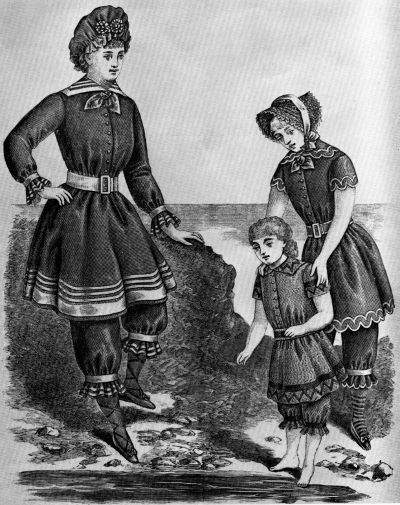
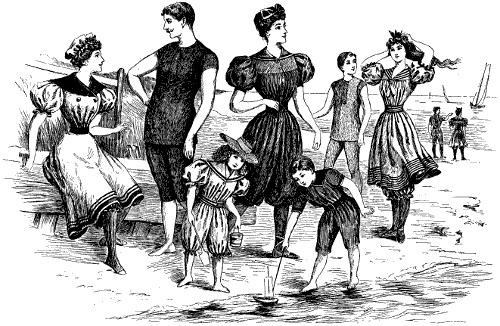
The featured 19thand early 20th century swim wear comes to you from Women’s bathing and swimming costume in the United States (Kidwell, C.B., 1968) which is in the Maritime Library stacks.  See the Keys Catalog of Library materials; it’s also accessible online via Project Gutenberg Ebook.

Perfect for San Francisco Bay weather...

Bathing costume, from the Delineator, July 1884
Figure 1.—Bathing costume, from The Delineator, July 1884. (Smithsonian photo 58466.)
Figure 12.—Bathing costumes from a supplement to The Tailor’s Review, July 1895.
(Courtesy of Library of Congress.)

Fickle weathered San Francisco Bay is paradise to many a floaty communities, including swimmers in our very own Aquatic Park Cove.  Others co-existing in the water include sailors, mariners, rowers, kite and windsurfers, stand-up paddle boarding, marine wildlife, houseboats... and what do they all have in common?  Debris!

Time in the Bay waters can be a close encounter with debris.  One swimmer contemplated debris while swimming in Aquatic Park Cove.  Here’s a link the still relevant San Francisco Bay Debris, produced by swimmer Amy Miller for KQED in 2007. You’ll also find other San Francisco Bay focused material in the Keys Catalog of the Maritime Library.

Be aware and be safe. Happy summer!