Showing posts with label manuscripts. Show all posts

Monday, April 28, 2014

Digging for Gold at the Library: A Mystery!

(by Gina Bardi, Reference Librarian)

This month I wrote a story about poetry in our collection for both our blog and our Park website. While researching, I came across a delightful find, HDC 35 (SAFR 17607), The Captain Thompson Poems and Illustrations Collection. After seeing his charming drawings, I wanted to learn more about him so I went to the collection files. It turns out, there’s a bit of a mystery surrounding the documents. As far as I can tell, the images and poems were sent to us unsolicited. The name of the donor was not Thompson and apparently they sent the work with no background information. In the file, there are numerous envelopes we sent to the donors asking for more information which were sent back to us marked “return to sender: not at this address”. 

There is a letter in the collection (see below; it’s highly amusing), that may or may not be in the same handwriting as the poems (some letters look similar, some very different, but the letter looks to have been quickly jotted down and perhaps not as much care taken as with the poems.) The letter is signed by an Alec Macson,  Moeson or something like that who purports to be club secretary.  The other gentlemen who signed the letter are sometimes mentioned in the poems. There is no Captain Thompson mentioned in either the letters or the poems.

The ship the author  mentions, is “The good ship Kay” or simply “K”.  I checked the American Bureau of Shipping and Lloyd’s registers in the years around 1914- there are no listing for a ship that begins with K having either a Thompson or a Riess (the man often referred to in the drawings) as a master.  
I checked the California Digital Newspaper Collection for a “Captain Riess” with no luck. There were too many Captain Thompsons to be sure. None of the articles about the various Captain Thompson mentioned poetry or illustrations.

 I have a feeling though the poet is British, due to some of the language in the poems. For instance, sailors are “crossed and crabbed” He also mentions Lobscouse, which is a typical sailor stew common on British ships. Lastly, the uniforms look distinctly British. Perhaps the stripes are just meant to be blue shading?
Here are some of the poems and the letter.  If you recognize the style at all or the names and can tell us anything about this clever and talented author, please let us know.


Tuesday, April 8, 2014

Digging for Gold at the Library: Poetry in the Archives

(by Gina Bardi, Reference Librarian)


It’s National Poetry Month and I bet you thought I was going to talk about the Rime of the Ancient Mariner or something by John Masefield.  While that would be wholly appropriate it would also be something you have most likely seen before, perhaps even here.  As the purpose of my installments is to dig for things buried deep in the collections for you to see, I had a much better idea. I went into our archives and pulled some poems written by various seafarers and passengers for your enjoyment.  As opposed to the stereotypical idea of a sailor as somewhat brutish and dull, many sailors were curious, intelligent and in tune with the natural world; after all, they depended on a deep knowledge of not just the sea but what was going both above and below it to survive. They had long stretches to contemplate the world around them and their connection to it. It’s no wonder some of them turned to. For instance, here’s a poem by Captain Roy Moyes from HDC 235 (SAFR 17110) expressing the feelings of being becalmed both literally and figuratively.

                Becalmed

                Only the sea, motionless in calm
                Only the hope of a stirring breeze;
                There’s naught, but the depth’s alluring charm,
                Rippling reflections in placid seas-
                Only the sails and the dawning sun.
                Only the loss of the foaming run.
               
                Yet, deep in the soul the sea reflects
                In the light of questing, seeking thoughts
                The cause of its wonderful objects
                The gale, the calm, the loneliness wrought.
                All is still; there is no when, or how-
                Only the presence of the now.

                The day drifts on, and at evening fall
                Golden painted clouds drift idly by:
                The sea lies still; and over it all
                The awe of silence reigns far and nigh.
                Patient we must be, whole darkness hides
                The ship and our fate on the still tides.

Moyes was once the captain of our very own Balclutha, when she was called the Pacific Queen.  Born in Australia to no seafaring parents, Moyes left home at 14 to start a career in the sea, working his way from ordinary seaman to captain. His time spent at sea must have given him much inspiration, for he wrote over 80 poems, many of them long form.  As far as I can tell, none have been published. 

One of my favorite lighter ones is a toast I found written on a scrap of paper in HDC 833, SAFR 8451, The Captain Peter Petersen Papers. Written at the top of the torn sheet is “This poem Miss Bradley had readen (sic) on the bottle when the skiff was launched this summer after she had painted it.”

                Here’s to Peter the Great
                May you ever sail in state
                Should your mistress have a date
                Be sure you’re never late


Image of the manuscript containing the toast


Scribbling on scraps seems to be a popular method of capturing a fleeting poem. We can’t be sure who this was written by, but it was found in the Walter W. Taylor Papers (HDC 1454, SAFR 21896). Taylor (or someone else) took a poem by C. Fox Smith entitled “Racing Clippers: A Wool Fleet Memory” and changed it to make it more personal.

Here’s the text of the Taylor collection poem:

                There ain’t no racin’ clippers now. Nor never will be again.
                And most o’ the ships are gone by now, the same as most of the men.
                Like the ships that made a forest on the ‘Frisco waterside
                The slashing big four masters from the Mersey on the Clyde
                An the Yankee sky’s’l yarders with their plankin’ scoured like snow
                loading grain at ‘Frisco,-- Forty years ago

Image of the manuscript


Another one found in the Taylor collection echoes the above poem with a lament of leaving the sea behind.

                When I was a boy I strolled
                around while the ships were
                outward bound.
                I had no tin to pay for
                gin so I just strolled
                around.
                My coat was out at the elbows
                I was hungry and footsore
                So I joined aboard a
                full rigged ship called the
                “Shanandore”
                No more will I go to the sea
                or roam the Western ocean
                a rolling and a bolling
                no more I ever will
                no more will I go to sea
                or roam the western ocean
                As long as I live I’ll stay
                on shore and go to sea more
                no more will I haul on a
                lee fore brace, or by those
                halyards stand.
                no more will I cry as
                aloft I fly with a tar pot
                in my hand.
No more will I swing on
                the big main yard or
                walk the capstan round.
                No more will I trim the
                royals while running the
                Easting down.


 I mentioned passengers as being poets and boy, do I have a doozy of an example for you. In 1849, an unidentified author set sail from Norfolk to San Francisco on the bark the John L. Colley (HDC 27, SAFR 13573). This passenger found the journey so disagreeable, that he wrote a 17 page screed  in verse against the captain, of whom he says, “He was the  mildest manner’d man who ever scuttled ship or cut a throat”.  Here’s the title page so you can see he means business:

Image of the manuscript


That’s a 0 star review if I ever heard one.

I’ll be writing a longer piece about poems in our collection for our website, so be on the lookout. As always, if you’d like to look at any of these poems or the many more in our collection, drop me a line gina_bardi@nps.gov.

(Addendum:  For more about poetry in the archives, see Poetry in Ocean.--Ed., Apr. 25, 2014)

Tuesday, February 25, 2014

SF History Expo, Mar. 1-2, 2014

(by Heather Hernandez, Technical Services Librarian)

Page from the Pangburn journal, kept aboard the Nautilus (HDC 59)

Join us at the San Francisco History Expo this weekend!  Collections staff will be bringing real artifacts and many high quality reproductions of archival materials that you can see up close, creating one of more than fifty "mini-museums" at the Old Mint.  Don't miss seeing the working model of the Park's scow schooner Alma, and learning about Gold Rush ships.

If you're on Facebook, you can rsvp to our event--we hope we'll see you there!

Tuesday, July 23, 2013

Union Iron Works project featured on The Signal

(by Heather Hernandez, Technical Services Librarian)

One of our projects, to create the online Union Iron Works Employee Card Collection, has been mentioned with other fascinating NPS digitization initiatives on the Library of Congress' blog, The Signal:  "Content Matters: An Interview with Staff from the National Park Service."

So far, through the efforts of staff, interns, and volunteers, over 400 cards for employees of the Union Iron Works shipyard in the 1910s have been digitized and are available online via NPS Focus (just enter these search terms: union iron works).  The hardcopy collection contains somewhere between 30,000 to 57,000 cards--we believe there is at least one card for every employee of the shipyard during this time period.  In addition to names, home addresses, occupation, they sometimes include age or year of birth, and country of origin--there is a wealth of data about an entire workforce during the WWI shipbuilding years in San Francisco, waiting to become more accessible.

In addition to full color scans of both sides of cards such as these:


Rich metadata records are being created to accompany the images, allowing them to be searched and retrieved by multiple terms including name, address (historic and current, if different and identifiable), occupation, and nationality.

In progress is a transcription database that will eventually make the entire dataset available to researchers on demand, in multiple formats.

Want to learn more?  There is a presentation available for viewing, and we'd love to hear from anyone interested in conducting research in the online or hardcopy collection, or in becoming involved in the project.

Wednesday, February 13, 2013

Digging for Gold at the Library: Marine Exchange records

(by Gina Bardi, Reference Librarian)

Every once and awhile, research questions will come in droves about a certain subject. Suddenly, everyone will want to know about a specific ship or event.  Usually this can be traced to news segment or TV show, but there are times when a collection just suddenly, mysteriously becomes popular.  In the last few weeks I’ve had quite a few requests for information in our Marine Exchange Records. They’re one of my favorite resources here and since everyone else is using them, you should be too. 


The San Francisco Marine Exchange was started in 1849. Its purpose was to look for and report vessels entering the bay.  Located atop Telegraph Hill (Here’s a good “didja know” to bring up at a cocktail party: Telegraph Hill got its name from the signal station there), the Marine Exchange would alert the city to incoming vessels by means of a wooden semaphore.  Everyone in San Francisco quickly learned what the signals met as evidenced by the oft repeated tale of a theatre performance being disrupted by howls of laughter when an actor on stage in response to a revelation in the play, threw his hands open in despair and lamented “What is this?” and a cheeky member of the audience yelled “It’s a sidewheel steamer.”
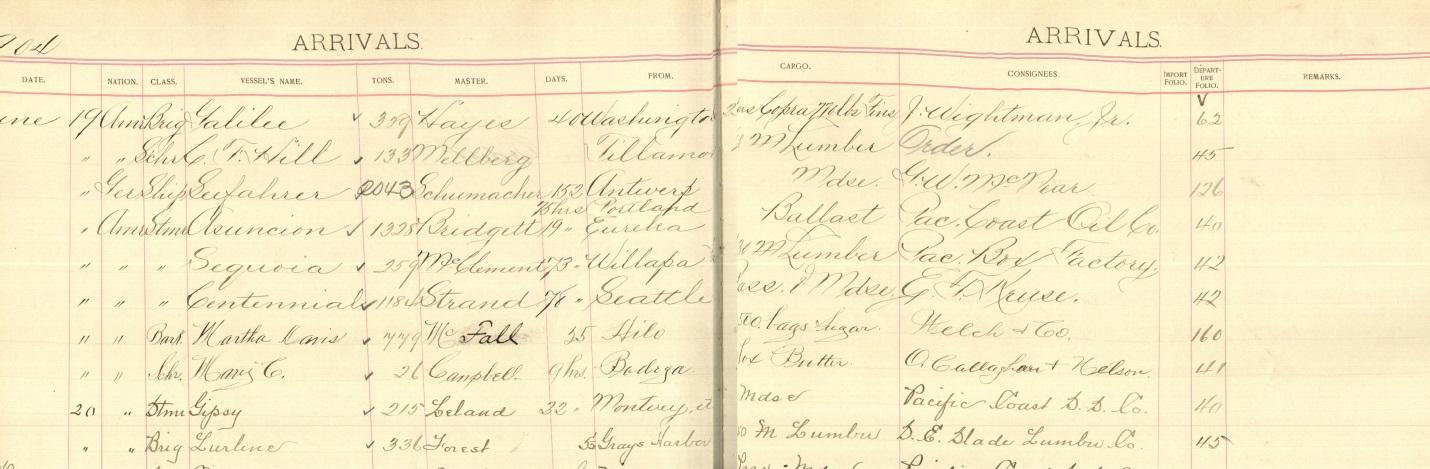
As I said, the Marine Exchange documented every vessel that came in or out of the bay. Our collection (HDC 559) includes:  12 Ledgers, scrapbooks of marine disasters, mishaps, and total losses, 102 Ledgers vessel arrivals/departures, indexed and a card index to arrivals by vessel name. Some of the collection is available on microfilm. The time span for the records is roughly 1886- 1982 for arrivals and departures and 1854-1962 for disasters, mishaps and total losses.  Here’s an example from Arrivals vol. 1 1904-1906. Note the first entry is the Mathew Turner  brig, the Galilee carrying a load of copra.


The ledger is so large it’s difficult to scan the entire page, but the information contained includes, date of arrival, nation, class name of vessel, tonnage, master, days from last port, cargo, consignees, import folio and departure folio and finally any remarks.  This is a heck of a lot of information.  There is no passenger information though. I REPEAT no passenger information (that’s for the intrepid genealogist who is already picking up the phone to call and see if their relative is listed- they’re not).

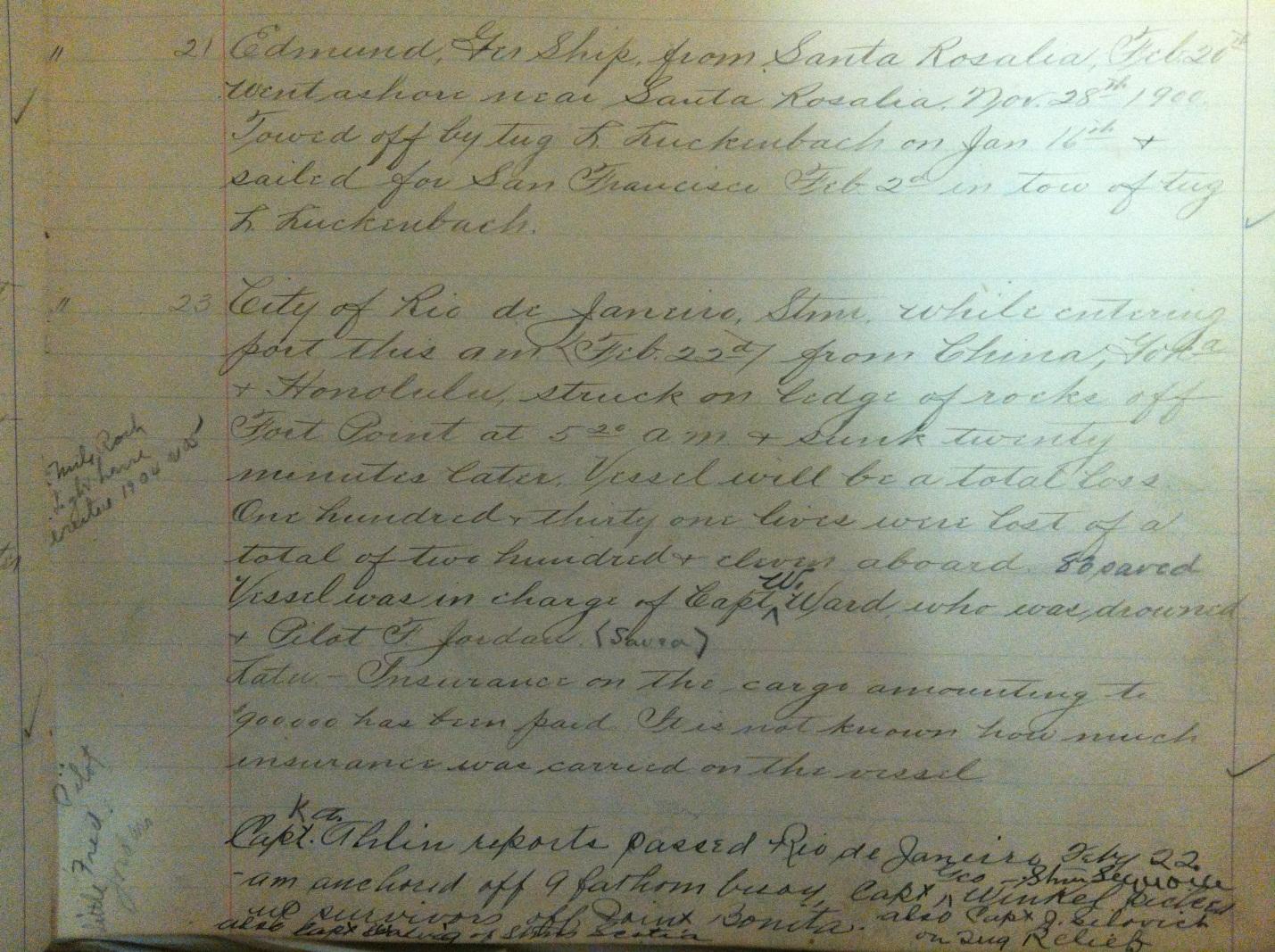
The Disaster and Mishaps and Total Losses ledgers are similar. Arranged by date, they list occurrences of cargos burned, masts snapped and crews lost with no traces to be found.  Some are detailed and seem to be retelling of Captains accounts, others are just a line or two.  Below is the entry from the Disaster log vol. 1 1900-1906 for the wreck of the City of Rio de Janeiro, a Pacific Mail steamer which hit a reef in San Francisco Bay.  131 people died. 


There is something for everyone in these records. It is my hope to have them all scanned and made available for researchers the world over.  Until then though, come to the library to see these unique records for yourself. 

The Marine Exchange Records (HDC 559 SAFR 18592) can be accessed in person by appointment. Some of the collection is available on microfilm and will be substituted for original material at the discretion of Collections Staff.  Please contact gina_bardi@nps.gov or call 415/561-7033. Scans or photocopies can be made as well at the discretion of the Collections Staff. Please see our Duplication Services for information on fees.

Tuesday, October 23, 2012

The Yacht Idler and the Library collections

(by Heather Hernandez, Technical Services Librarian)

What does the logbook of the yacht Idler in our Archives have to do with the Library collections?  Hint:  the answer lies in the pages below!


The full explanation is now available on the new page on our website written by Archives Specialist Ed LeBlanc, "Logbook of the yacht Idler linked to Library."