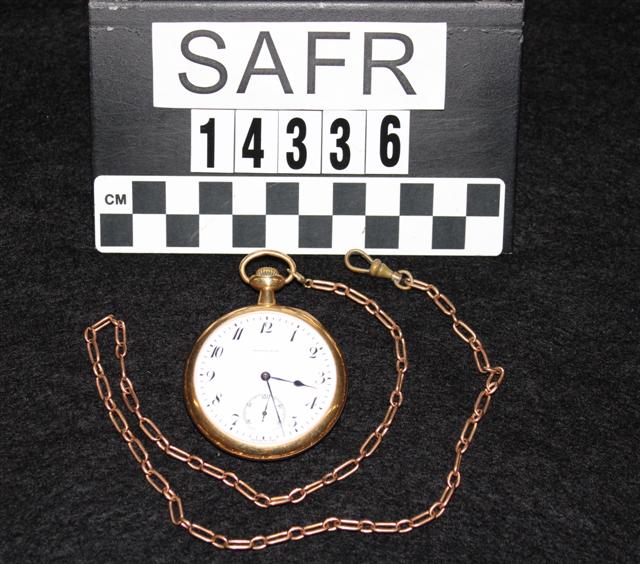
(by Diane Cooper, Museum Specialist)
 |
| Watch with gold chain (NPS photo) |
Some of the most interesting historical adventures occur while I’m traveling along the road to somewhere else chasing some other historical incident. The other day while working with the Park’s collection on another project, I came across a beautiful gold pocket watch engraved with the initials “RBG” on the back case. A curious inscription on the inside cover caught my attention and my curiosity, sending me on an unexpected journey through history. The inscription read:
Presented by
the San Francisco Underwriters
on the steamer “Cricket"
to
R.B. Goodwin, Chief Engineer
for meritorious services
during the fire at Portland
March 12, 1914
 |
| Inscription, inside cover (NPS photo) |
For some reason, I just had to know the whole story behind the watch, the man, the steamer and the incident. My education as a maritime historian and my work as a museum technician piqued the historical detective in me. And so, in words of the famous literary detective Sherlock Holmes, “the game was afoot.”
Before beginning my investigation, I needed to determine exactly what I hoped to discover. I identified four basic research questions I wanted to answer. These were:
1. Who was R. B. Goodwin?
2. How severe was the fire that occurred in Portland, Oregon on March 12, 1914?
3. What did R.B. Goodwin do to save the Cricket from that fire?
4. Even though the fire took place in Portland, how were the watch, R. B. Goodwin, and the Cricket related to San Francisco?
I decided to try to confine my search to online sources I could view during my lunch hour. First step in my search was to review the Park’s catalog record and file. The only new clue found in that record was the fact that the Cricket was built locally at an Alameda ship yard in 1913. My visual inspection of the watch had revealed it was made of 19k gold in Switzerland for Shreve & Company, a local San Francisco jeweler established in 1852.
A quick check of Google turned nothing up on either R.B. Goodwin or the Cricket. At least that was one potential information source I could now rule out. I hoped my next online source would be more fruitful.
With no primary sources readily available, I turned to other sources. Although Holmes insisted “There is nothing like first-hand evidence,” a great source of information, though one has to be somewhat skeptical of its facts, is the contemporary news reports. I started searching the San Francisco newspapers, a herculean task that use to require days, weeks, even months to complete. But today, that’s no longer true, thanks to the people at UC Riverside and their online California Digital Newspaper Collection. The search still requires time and patience, but it can be accomplished from your computer and at your convenience.
Searching on the keywords “fire, Portland, wharf, Cricket” I found numerous articles, most of which did not refer to my topic. Three articles, however, were on the mark. The first article was from the San Francisco Call and described a fire on board the steamer Cricket while docked at Pier 38 in San Francisco on 5 November 1913. Even though this fire was not the one referred to by the watch, it told me that the Cricket had been in San Francisco and was no stranger to fire.
Neither of the next two articles mentioned the Cricket, but they gave me details about the Portland wharf fire of 1914. On 21 March 1914 the Pacific Rural Press, the farmer’s newspaper, reported that approximately 9,000 tons of wheat were destroyed in a dock fire in Portland. The same day the Sausalito News described the Portland fire as “the most devastating conflagration in its history … when two mammoth grain wharves, laden with wheat, were completely destroyed, and two large vessels were ruined almost beyond repair and a dozen buildings were damaged by the driving flames” resulting in an estimated $1,000,000.00 in damages. In addition, one fireman was seriously injured and four others barely escaped death while fighting the blaze
While this gave me an understanding of just how severe the fire had been, it didn’t tell me about the Cricket or R.B. Goodwin. A second search was required, this time using the key words “fire, Goodwin, Cricket.” And there it was, the only article in the database that included all three of those words and contained the answers to my research questions. In the May 1914 the following article appeared in the American Engineer on page 30:
The Burning of the Steamer “Cricket”
While laying at the dock at Portland, Oregon, on the morning of March 12th, the Cricket took fire from the wharf and at the time was loaded on deck with asphaltum in barrels.
At 4:30 a.m. the first assistant engineer was awakened and heard the crackling of the flames and immediately gave the warning. The three engineers went to the engine-room and got the fire-pump started and started the main engine to attempt to break the lines, thereby getting the steamer clear of the dock. The chief went back on deck and got a fire hose out and began to play a stream on the vessel. As the deck department had left the steamer in a boat it remained for the engineers’ department to do what was possible, but after making a fight for about fifteen minutes they saw that it was time to look out for themselves and called to the police boat to take them off; the fire was now raging so badly that they did not dare come alongside, so those that were left on board jumped overboard and were picked up by a launch. The fire was confined to the upperworks and after the survey was housed over and came to San Francisco under her own steam, and is now being rebuilt at the United Engineering Works.
To show their appreciation for the heroism and attempt made by the engineers to save the steamer, the Board of Underwriters on April 17th, 1914, presented Chief-engineer Roy B. Goodwin with a beautiful gold watch and chain, the case of the watch being engraved to commemorate the purpose for which it was given, also giving him a month’s salary. First assistant engineer H.G. Fowle and second assistant engineer R. F. Blake each received a month’s salary and a letter of recommendation.
Now I knew what Goodwin did to “save” the Cricket and that the Cricket was almost certainly one of the “two large vessels … ruined almost beyond repair” in that fire. I also knew that Goodwin did not act alone. My next step was to check the U.S. Censuses for 1910 and 1920 to try and learn a bit more about Roy B. Goodwin and his co-workers H.G. Fowle and R. F. Blake. The two sources I used for this search are Ancestry.com (subscription based) and the free databases of Family Search.
My search of the 1910 census located an entry for the household of Roy B. Goodwin. Included in his family were his wife, Amelia, their two daughters, Helen and Marion, and his older brother, Frank. Frank also worked on steamships as a seaman. The household of Roy and Amelia Goodwin also turned up in the 1920, 1930, and 1940 censuses.
 |
| 1910 U.S. Cenus entry for the Roy B. Goodwin family and household |
I also searched the 1910 census for H.G. Fowle and R.F. Blake. It contained one entry for “H.W. Fowle” and listed him as living in a boarding house at Broadway Wharf and Powell. A North Dakotan, the 25 year old Fowle was employed as a 2nd Engineer on an ocean steamer with what appears to be the entire crew, from the Captain to the bell boy, living in the same boarding house. This might be the Cricket’s H.G. Fowle, but I cannot verify that fact. The census also contained one entry for “R.A. Blake,” a 29 year old 2nd Engineer on the steamer Charles Nelson, which was docked at Pier 16. Again, this could be the Cricket’s R.F. Blake, but I cannot verify that fact. Neither Fowle nor Blake appeared in the 1920 census.
I made a quick call to our Reference Librarian, Gina Bardi (I know, she’s not really an online source but she’s a really good source), and asked her to see if she could find these three men in a San Francisco directory around 1914. Roy Goodwin, a marine engineer, and his family were in the 1914 directory living at 40 Lloyd Street. Neither Mr. Fowle nor Mr. Blake were listed in the San Francisco directories between 1912 and 1916.
While Gina searched the directories I looked at links I found for a World War II draft registration record, two passenger [crew] lists from 1942, and a death record, dated 18 June 1948, for a Roy Burton Goodwin, born on 25 July 1884. A quick search of the 1900 census yielded a record for Roy B. Goodwin, son of Francis W. Goodwin and younger brother of Francis E. Goodwin, with a birth date of July 1884. Now I knew Roy’s middle name and his death date. I also knew he served in the Merchant Marines during World War II.
Here my journey, and my lunch hour, ended. But I had discovered (1) who R.B. Goodwin was, (2) how destructive the Portland fire was, (3) what Goodwin did to receive the accolade of “meritorious service” while trying to save the steamer Cricket, and (4) that the steamer Cricket, built in Alameda in 1913, sailed in and out of San Francisco, that Roy B. Goodwin lived in the City from at least 1910 until his death in 1948, and that the watch was purchased from a well-known San Francisco jeweler by the local insurance underwriters who were saved the expense of a ship declared a “total loss” by the actions of the ship’s engineers.
I also learned that Goodwin was bravely assisted by H.G. Fowle and R. F. Blake in his fight to save the Cricket and that all three men received commendations for their actions. While I still don’t know anything definite about Fowle and Blake, I found personal information in the 1910 census about two men who may possibly be those Cricket engineers.
As with all good investigative journeys, the answers to my questions merely point me in the direction of new questions I’d like to answer. (Questions like: What cargo did the ships Archbishop Lamy and Elihu Yale carry and what ports did they visit in 1942? Did Roy serve on other merchant vessels during the war? What did Frank do? What did become of H.G. Fowle and R.F. Blake?) Being a historical detective is a never-ending job that allows me glimpses of the past, introduces me to interesting characters, and takes me on exciting journeys, many without ever leaving my computer. You should give it a try.
 |
| Cover with initials, "RBG" (NPS photo) |