Showing posts with label vessels. Show all posts

Tuesday, May 6, 2014

New in the Library: Color your 1946 world

(by Heather Hernandez, Technical Services Librarian)

Now available in the Library, Pittsburgh Marine Finishes is a full color catalog of the marine paints and coatings that were available from the Pittsburgh Plate Glass Company in 1946.  Sleek vessels illustrate the front and back covers:

Front cover

Back cover

And inside you'll find full color illustrations of the possible applications for many types of vessels, large and small, showing vessel exteriors as well as interiors:


And, of course, no catalog would be complete without the swatches.  The catalog contains page after page of samples of colors and finishes such as this one:


For the vessel or the home, this volume is a wealth of inspiration for anyone seeking color inspiration--especially mid-20th century color inspiration!


Tuesday, March 18, 2014

Happy birthday Rudolph Diesel

(by Heather Hernandez, Technical Services Librarian)

On this day, March 18, in 1858 Rudolph Christian Karl Diesel was born in Paris.

Diesel in 1883 (credit: Wikipedia)

What does he have to do with the collections of San Francisco Maritime NHP?  He invented the diesel engine!  Sure, our collections are strong in wind-powered ships and boats, but without Diesel's invention, would we have such rich archival collections, artifact, or library collections?  Certainly not!  Plans, technical manuals, and histories--from pleasure boats to cargo ships--all with Diesel's invention at their heart.  Celebrate Diesel's birthday today by exploring diesel power in our maritime collections.

Tuesday, September 17, 2013

Digging for Gold at the Library: Lloyd's Register online!

(by Gina Bardi, Reference Librarian)

In my reference work, I have what I like to refer to as my “Greatest Hits” these are books I constantly refer to, almost every day. They are the work horses of the library (Greatest Work Horse Hits?). One of these is our collection of Lloyd’s Registers. Lloyd’s Registers are a serial publication which began in the 1760’s in a coffee house of London. Two things you should know about Lloyd’s Registers: 1) They are not affiliated with that other Lloyd’s which also started in the same coffee house and insures things like Betty Grable’s legs and Marlene Dietrich’s voice (although I am going to make a huge tangential leap further down and combine Lloyd’s of London, Lloyd’s Register and Marlene Dietrich in a roundabout sort of way) 2) Lloyd’s Register does not register vessels, despite the name. They classify vessels. But I guess “Lloyd’s Classifieds” didn’t sound as snazzy to those coffee drinking blokes as Lloyd’s Registers. More specifically, Lloyd’s Register was/is a way for merchants and underwriters to get to know the vessels they were insuring, buying or doing business with. Lloyd’s would rate a ship based on a variety of factors giving ones that rated the highest an “A1” rating. As a result, there’s thousands and thousands pages of data about the nitty gritty of thousands and thousands of vessels, which is a very welcome side benefit to researchers, genealogists, model makers and general enthusiasts alike. And now… they’re online! Not all, but from 1764-1874 and some volumes in the 1880’s available here, which also  links to additional registers from 1930 to 1945.

Lloyd’s Registers is for vessels classified in Great Britain. For good ol’ USA vessels, you’ll want to use American Lloyd’s and the Record of American and Foreign Shipping (which we refer to as ABS as it’s produced by the American Board of Shipping). 1859-1900 are available from the Mystic Seaport library. 

Now, here’s where I tie Marlene Dietrich, Lloyd’s of London and Lloyd’s Register together. Let’s say you’re a Marlene Dietrich fan (and if you’re not, you should be). As I mentioned above, it’s been rumored that Lloyd’s of London insured her legs for a million dollars. In 1938, when Marlene Dietrich came back to the United States to become a US Citizen, she was on the SS Normandie. And voila! Here is the Lloyd’s entry for the SS Normandie.  

Now you can write the most complete biography of Marlene Dietrich that is so detailed, it mentions what kind of engines the SS Normandie had (Steam turbines connected to electric motors).

Here’s our record in Keys for Lloyd’s Registers.

Have fun searching!

Tuesday, September 10, 2013

Tacking ship

(by Heather Hernandez, Technical Services Librarian)

This week we're offering a longer rhyme, "Tacking Ship" (also known as, "Tacking Ship Off Shore") by Walter Mitchell, included in Nautical Nursery Rhymes by Billy Ringbolt, which resides in the Peterson, Peter H. (Capt.) Papers, (SAFR 18665, HDC 571).  With this poem, the verses in the book become  more narrative.

Tacking Ship

The weather leech of the topsail shivers,
The bowlines strain, and the lee shrouds slacken,
The braces are taut, and the little boom quivers,
And the waves with the coming squall-cloud blacken.

Open one point on the weather bow
Is the lighthouse tall on Bonita Head,
There's a shade of doubt on the Captain's brow,
And the pilot watches the heaving lead.

I stand at the wheel and with eager eye 
To sea and to sky and to shore I gaze,
'Till the muttered order of "Full and by!"
Is suddenly changed to "Full for stays!"

The ship bends lower before the breeze,
As her broadside to the blast she lays,
And she swifter springs to the rising sea,
As the pilot calls "Stand by for stays!"

It is silence all as each in his place,
With the gathered coil in his hardened hands,
By tack and bowline, by sheet and brace,
Waiting the watchword impatient stands.

And the light on Bonita Head draws near,
As, trumpet winged the pilot's shout
From his post on the forecastle head I hear,
With the welcome call of "Ready! About!"

No time to spare!  It is touch and go;
And the Captain growls, "Down helm, hard down!"
As my weight on the whirling spokes I throw,
While the heavens grow black with the storm cloud's frown.

High over the knight heads flies the spray
As we meet the shock of the plunging sea,
And my shoulder stiff to the wheel I lay
As I answer, "Ay, ay, sir!  Hard alee!"

With the swerving leap of a startled steed,
The ship flies fast in the eye of the wind.
The dangerous shoals on the lee recede
And the headland white we have left behind.

The topsails flutter, the jibs collapse,
And belly and tug at the groaning cleats;
And spanker slats, and mainsail flaps;
And thunders the order, "Tacks and sheets!"

'Mid the rattle of blocks and the tramp of the crew,
Hisses the rain of the rushing squall;
The sails are aback from clew to clew,
And now is the moment for "Mainsail haul!"

And the heavy yards, like a baby's toy,
By fifty strong arms are swiftly swing;
She holds her sway and I look with joy
For the first white spray over the bulwarks flung.

"Let go, and haul!"  'Tis the last command,
And the head sails fill to the blast once more.
Astern and to leeward lies the land,
With its breakers white on the shingly shore.

What matters the reef, or the rain, or the squall?
I steady the helm for the open sea;
The first mate clamors, "Belay, there all!"
And the Captain's breath once more comes free.

And so off shore let the good ship fly,
Little care I how the gusts may blow,
In my fo'castle bunk in a jacket dry,
Eight bells have struck, and my watch is below.


Tuesday, August 27, 2013

Caution

(by Heather Hernandez, Technical Services Librarian)

This week we're offering another instructive rhyme from Nautical Nursery Rhymes by Billy Ringbolt, which resides in the Peterson, Peter H. (Capt.) Papers, (SAFR 18665, HDC 571).  This one seems applicable to land "vessels" as well!


Caution

Every steamer or ship in fog, mist or snow,
At a moderate speed is directed to go.

Tuesday, August 13, 2013

Anchor in Fog

(by Heather Hernandez, Technical Services Librarian)

This week we're offering another instructive rhyme from Nautical Nursery Rhymes by Billy Ringbolt, which resides in the Peterson, Peter H. (Capt.) Papers, (SAFR 18665, HDC 571):


Anchor in Fog

When feeling your way, if you hear a ship's bell,
It's a vessel at anchor, you can easily tell,
Her bell in a fog is her only provision,
As signals to others to save a collision.

Tuesday, July 9, 2013

Ships by John Masefield

(by Ted Miles, Assistant Reference Librarian)

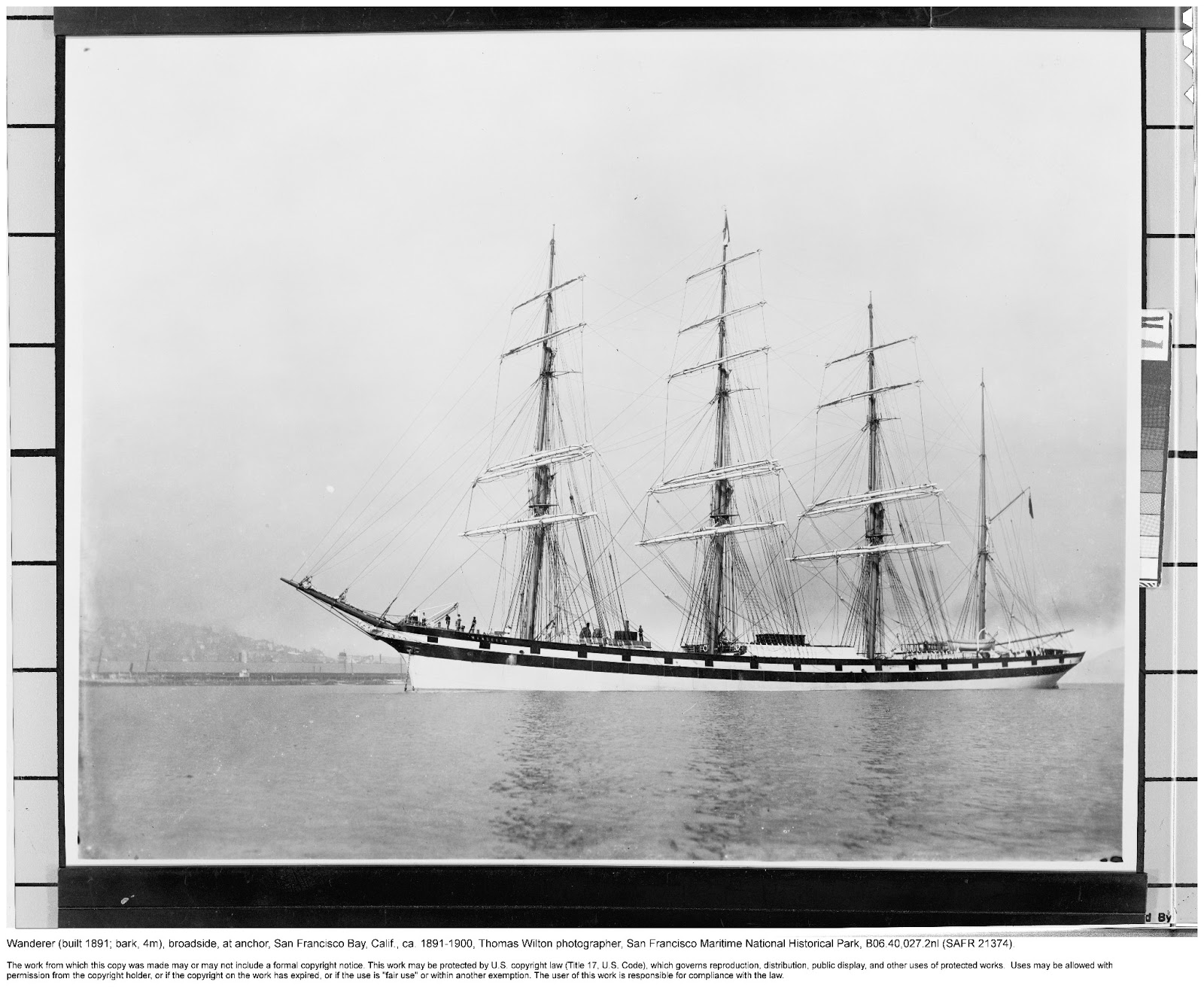
Black and white photo of vessel on the water
Wanderer of Liverpool at anchor in San Francisco Bay, circa July 1892.
Photo by Thomas H. Wilton (B6 40,027nl)

John Masefield  ( 1878-1967) started by joining the Training Ship Conway intending to be an officer in the British Merchant Navy at that time the largest in the world. After completing his schooling in 1894, he went to sea as an Apprentice in the Gilcruix (iron 4 mast ship, built 1883) and several other vessels; he had seen the famous and beautiful Wanderer (steel 4 mast bark, built 1890). He wrote a detailed biography of the vessel. But he had to abandon his sea career due to poor health. After a period of odd jobs he settled into a successful career of writing and lecturing in England and the United States.

But his early life at sea provided the creativity that produced Salt Water Ballads in 1902. And many of his sea poems also appeared in his Collected Poems in 1922 which sold over 80,000 copies.

The poem is a tribute to the Port of Liverpool and to the vast fleet of ocean going square riggers that once crowded its harbor and wet docks. From it comes:

Lochs, Counties, Shires, Drums, the countless lines
Whose house-flags were all once familiar signs
at high main-trucks on Mersey’s windy days
When sunlight made the wind-white water blaze.
Their names bring back old mornings, when the docks
Shone in their house-flags and their painted blocks,
Their raking masts below the Custom house
And all the marvelous beauty of their bows….
That nobleness and grandeur, all that beauty
Born of a manly life and bitter duty,
That splendor of fine bows which yet could stand
The shock of rollers never checked by land.
That art of masts, sail crowded, fit to break,
Yet stayed to strength and backstayed into rake,
the life demanded by that art, the keen
Eye-puckered, hard-case seamen, silent lean,--
They are grander things than all the art of towns,
Their tests are tempests and the sea that drowns,
They are my country’s line, her great art done
By strong brains laboring on the thought unwon,
They mark our passage as a race of men,
Earth shall not see such ships as these again.

This last couple of lines is the most often quoted of Masefield’s poetry. The poet became Poet Laureate of the United Kingdom in 1930 and was given an honorary doctorate from Cambridge University in 1931. That is a pretty successful effort for a boy who liked to read and expected to go to sea in a square-rigged sailing vessel.   

The Poems and Plays of John Masefield (Volume One Poems) by John Masefield, (New York: The MacMillan Company) 1922. Pages 68, 69, 70 and 71. 


Tuesday, April 23, 2013

Telegraph Ship


(by Heather Hernandez, Technical Services Librarian)

This week we're offering another instructive rhyme from Nautical Nursery Rhymes by Billy Ringbolt, which resides in the Peterson, Peter H. (Capt.) Papers, (SAFR 18665, HDC 571):

Telegraph Ship

A telegraph ship whil'st working a cable,
To get out of the way is clearly not able,
So three lights she carries all through the whole night,
Two of them red and the middle one white;
Her signals by day with the night will compare,
She has two of them round and the middle one square.

Tuesday, April 9, 2013

At Anchor

(by Heather Hernandez, Technical Services Librarian)

This week we're offering another instructive rhyme from Nautical Nursery Rhymes by Billy Ringbolt, which resides in the Peterson, Peter H. (Capt.) Papers, (SAFR 18665, HDC 571):

At Anchor
A vessel which at anchor rides,
Hoists a light which shows all sides,
And for a mile is seen at night,
(If weather is fine) when burning bright.

Tuesday, March 26, 2013

Photo Archives Spotlight: A River Tyne Paddle Tug Arrives in San Francisco

(By M. Crawford, Processing Archivist)
Two recently processed collections (cue Simon and Garfunkel’s Bridge over Troubled Water) will take you back to March 24, 1970, and a British Invasion of the nautical kind. The George R. Lamuth photographs and the H. Alan Sims photographs of the Eppleton Hall (built 1914; tugboat) are collections of 28 and 56 slides, respectively, documenting the approach, celebration, and new home of Eppleton Hall in San Francisco.

Color slide, 2 x 2 inches. Photographed by George R. Lamuth. Eppleton Hall (built 1914; tugboat) is flanked by a fire boat spraying water, and three other vessels as she steams in the San Francisco Bay towards Fisherman’s Wharf after a six month and 10,000 mile voyage from Newcastle-upon-Tyne, England, to San Francisco, California.
Fireboats and spectators welcome Eppleton Hall as she makes her way
Fisherman’s Wharf. Photo by George R. Lamuth. (P99-015, Item 7)

A web link to the George R. Lamuth photographs of the Eppleton Hall (built 1914; tugboat) guide with more information about this collection including content, arrangement, histories and access.
Click for Collection Guide

George R. Lamuth photographs of the Eppleton Hall (built 1914; tugboat), 1970 March-1989 September, P99-015 (SAFR 23143)


A web link to the H. Alan Sims photographs of the Eppleton Hall (built 1914; tugboat) guide with more information about this collection including content, arrangement, histories and access.
Click for Collection Guide
H. Alan Sims photographs of the Eppleton Hall (built 1914; tugboat), circa 1950s, 1970 March 24, P99-014 (SAFR 22590)


Color slide, 2 x 2 inches. Photographed by H. Alan Sims. A sign lettered with calligraphy giving the details of the journey of Eppleton Hall (built 1914; tugboat): “This Steam Paddle-Tug is the last one in the world. She sailed 10,000 miles - Newcastle-upon-Tyne, England to San Francisco, California. The voyage took 6 months and 1 week, through 3 severe storms, entirely under her own power, with a San Francisco crew.”
An epic journey it was!
As if this wasn't dramatic enough, add to the plot three 
children aboard for the journey, illness in Mexico, and some 
colorful disagreement about the way to run a ship, and you 
have yourself an adventure. Photographed by H. Alan Sims.
(P99-014, Item 4)

You will have to bring your own band, but you can still experience the crowds, camera crews, and first glances of this relic as she steams into San Francisco. The measures taken to pull the burned-out hull of this steam side-wheeler out of the mud and return her to full operation were tremendous--a labor of love, indeed--and her arrival from Newcastle, England, was a day of exuberance. H. Alan Sims, of the Sacramento Area, and George Lamuth, life-long San Franciscan, were there to capture it on film for all of us that couldn't be there and for all of us who choose to relive it.


Color slide, 2 x 2 inches. Photographed by H. Alan Sims. Closeup of the builder’s plate that was installed on the vessel upon her 1969 renovation.
Builder’s plate from the restoration of  Eppleton Hall.
William “Bill” Bartz, went to Newcastle with Karl Kortum 
and Scott Newhall to purchase the paddle tug. He stayed 
with her while she underwent her renovation in England, doing 
much of the work himself. Photographed by H. Alan Sims.
(P99-014, Item 38)

Peruse the collection guides on the Online Archive of California to explore more, or while you’re in the mood, make an appointment with our reference staff to see the collections in person. While you’re here, feel free to pull Captain Scott Newhall's book on the Eppleton Hall (Call No. G470 N4) off the public reference shelf, or request a look at the logbook of her journey to San Francisco (HDC 1137, SAFR 17686). There's more to be found; it's only a reference request away.

Wednesday, March 6, 2013

Photo Archives Spotlight: From Wooden Boats to Steel Hulls

(by Amy Croft and M. Crawford, Project Archivists)

Two newly processed collections at San Francisco Maritime represent the diverse talents of Northern California residents. From designing commercial vessels to building wooden boats by hand, these creators reflect the difference in the scale of maritime craft and the different processes of building boats and ships.

Online Archives of California link to the William H. Grunwald photographs collection guide.
Click for Collection Guide

William H. Grunwald photographs, circa 1960-1997. Collection No. P99-007 (SAFR 19671)

Image: black-and-white photographic print. Detail of photograph of Aeolus Boats logo burned into wood.
Aeolus Boats logo burned into wood.
(P99-007, Ser. 1, File 1, Item 1.1)
If your interests are in wooden boats and small craft and you don't know about Aeolus Boats in Davenport, California, you'll probably want to. The William H. Grunwald photographs (SAFR 19671, P99-007) come from the owner of Aeolus Boats and  builder of fine craft himself, and were recently processed and made available for research by the Historic Documents Department.
Image: 3.5 x 5 inch, color photographic print. Grunwald is standing next to a boat he is framing. He has a saw in his hand and is looking at the camera.
Bill at work in his boatshop.
(P99-007, Ser. 1, File 2, Item 18.3)

Over the course of his 40 year career building boats, Bill Grunwald, became a prominent and established boat builder in Northern California. Born in Seattle and raised in Alameda, Grunwald bought a barn in Davenport and began Aeolus Boats in the 1950s. He first built sailboats; later concentrating his efforts on custom boats. He used about 26 designs for rowing boats, punts, dories, and yacht tenders.

The photos date from around 1960 to 1997 and depict mainly boats built by Grunwald. They are shown being constructed, out and about on various San Francisco Bay Area waters, and they are often occupied or surrounded by people enjoying themselves. Awaiting your discovery are photographs from photo essays, prospective and satisfied customers, as well as Grunwald's personal collection, making up three photo albums and 124 loose photoprints. Take a look to view the construction of the boat hulls, the boat shop itself, and a master at work (and sometimes at leisure.)


Image: 3.5 x 5 inch, color photographic print. Keel and hull view of a boat on blocks, under construction, at Grunwald's Aeolus Boat Shop.
Grunwald’s shop with his boats under construction. (P99-007, Ser. 1, File 3, Item 3.2)

Online Archives of California link to the L. Christian Norgaard photographs collection guide.
Click for Collection Guide

L. Christian Norgaard photographs, circa 1954-1985. Collection No. P95-035 (SAFR 22581) 


Black-and-white photographic print, 8 x 10 inches. Norgaard is standing on gangplank of the vessel. He is on the left. There is one woman and a man next to him on the stairs. Three men are standing below on the dock. The men are all wearing suits, some wearing hats. The Mokuhana name is seen painted on the vessel in the background.
Norgaard, upper left, celebrates
delivery of Mokuhana.
(P95-035, Ser 1, File 1, Item 4.1)
These photographs are from the prodigious work of local naval architect and marine engineer, "Chris" Norgaard. Chris was a longtime resident of the San Francisco Bay Area and Sacramento, California. His career spanned from the design of small craft and large cargo vessels to the design of replicas and historic ship renovations. He was responsible for the design of over 400 vessels seen from Los Angeles, California, to the fisheries and canneries of Alaska. He designed the cargo vessels Mokuhana and Komoku for Bay and River Navigation Company to transport sugar from the C & H Sugar Refinery at Crockett, California, to distribution points across San Francisco Bay including C & H’s headquarters at the city’s now historic landmark Pier One. Norgaard is perhaps best known for his designs of the replica of Sir Francis Drake's flagship Golden Hinde, Western Pacific's train ferry Las Plumas and the Red and White Fleet of sightseeing boats on San Francisco Bay during the fifties, sixties and seventies. He also worked on restorations of famous vessels, such as President Roosevelt's yacht Potomac.

Black-and-white photographic print, 8 x 10 inches. A young blonde girl in shorts and long sleeves stands in front of the Kort Nozzle propeller of an unidentified tug as it sits in dry dock. This photograph is from the album, Tugs--Designs by L. Chris Norgaard--Vol. 1.
Girl inside of kort nozzle on unidentified tug.
(P95-035, Ser 1, File 3, Item 2.26)
Notably, Norgaard was responsible for numerous maritime engineering innovations, such as the adoption, development and design of the "Kort Nozzle" on U.S. West Coast vessels.  He also authored and compiled a number of technical papers and books, including Golden Hinde II: A Galleon, c1570 (1974).

The collection holds 15 photo albums, loose photographs, and loose album pages (2.4 linear feet) documenting tugboats, cargo, passenger, public, and fishing vessels that he worked on from the 1950s to the 1970s. Many photographs depict the construction and christening of new vessels as well as exterior views of vessels at work. In addition, you will find Norgaard’s personal papers and over 1,300 vessel plans in the Loring Christian Norgaard historic documents collection, HDC 1294.


Black-and-white photographic print mounted on paper, 8 x 10 inches. The vessel is underway with full sail. Norgaard designed and oversaw the construction of this replica of the original GOLDEN HINDE, from 1971-1973.
Golden Hinde II
(P95-035, Ser 1, File 4, Item 1.2)
Make an appointment to take a closer look at the art of wooden boat building and ship design through these photographs -- some of them may document some vessels you may have seen with your own eyes cruising San Francisco Bay waters. Peruse the collection guides on the Online Archive of California to explore more on your own or contact our reference staff to guide you.

Wednesday, February 27, 2013

Disabled Vessel

(by Heather Hernandez, Technical Services Librarian)

This week we're offering another instructive rhyme from Nautical Nursery Rhymes by Billy Ringbolt, which resides in the Peterson, Peter H. (Capt.) Papers, (SAFR 18665, HDC 571):

Disabled Vessel
If a vessel's disabled and cannot well steer,
By break down of engines, or perhaps steering gear,
Two lights she will show from her foremast head,
One under the other, and both of them red.
By day two balls hoisted in this same position
Will explain to all vessels her helpless condition.

Wednesday, February 13, 2013

Digging for Gold at the Library: Marine Exchange records

(by Gina Bardi, Reference Librarian)

Every once and awhile, research questions will come in droves about a certain subject. Suddenly, everyone will want to know about a specific ship or event.  Usually this can be traced to news segment or TV show, but there are times when a collection just suddenly, mysteriously becomes popular.  In the last few weeks I’ve had quite a few requests for information in our Marine Exchange Records. They’re one of my favorite resources here and since everyone else is using them, you should be too. 


The San Francisco Marine Exchange was started in 1849. Its purpose was to look for and report vessels entering the bay.  Located atop Telegraph Hill (Here’s a good “didja know” to bring up at a cocktail party: Telegraph Hill got its name from the signal station there), the Marine Exchange would alert the city to incoming vessels by means of a wooden semaphore.  Everyone in San Francisco quickly learned what the signals met as evidenced by the oft repeated tale of a theatre performance being disrupted by howls of laughter when an actor on stage in response to a revelation in the play, threw his hands open in despair and lamented “What is this?” and a cheeky member of the audience yelled “It’s a sidewheel steamer.”
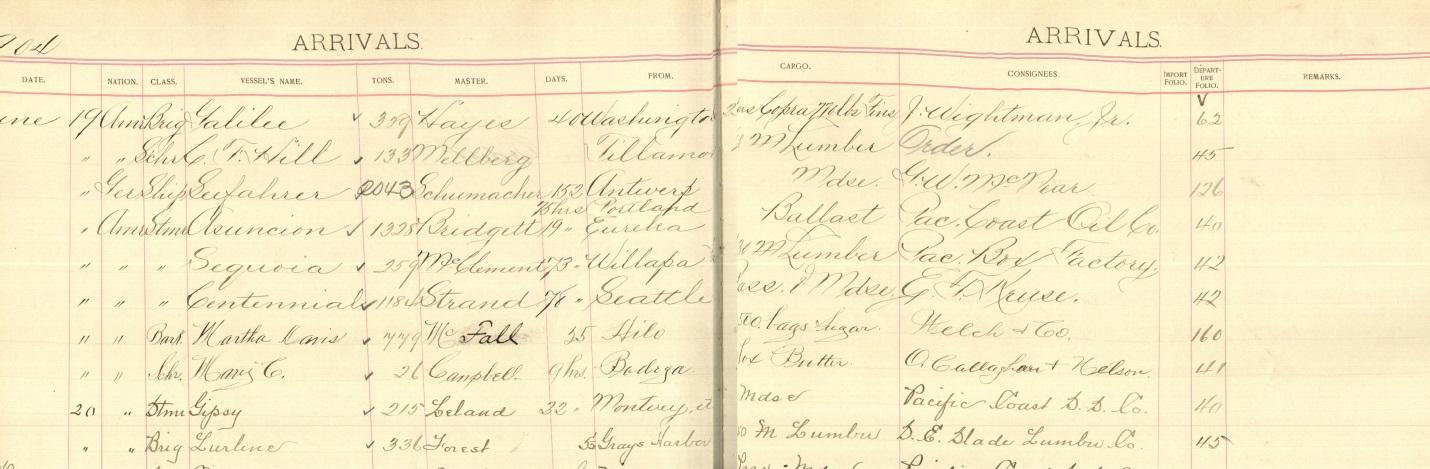
As I said, the Marine Exchange documented every vessel that came in or out of the bay. Our collection (HDC 559) includes:  12 Ledgers, scrapbooks of marine disasters, mishaps, and total losses, 102 Ledgers vessel arrivals/departures, indexed and a card index to arrivals by vessel name. Some of the collection is available on microfilm. The time span for the records is roughly 1886- 1982 for arrivals and departures and 1854-1962 for disasters, mishaps and total losses.  Here’s an example from Arrivals vol. 1 1904-1906. Note the first entry is the Mathew Turner  brig, the Galilee carrying a load of copra.


The ledger is so large it’s difficult to scan the entire page, but the information contained includes, date of arrival, nation, class name of vessel, tonnage, master, days from last port, cargo, consignees, import folio and departure folio and finally any remarks.  This is a heck of a lot of information.  There is no passenger information though. I REPEAT no passenger information (that’s for the intrepid genealogist who is already picking up the phone to call and see if their relative is listed- they’re not).

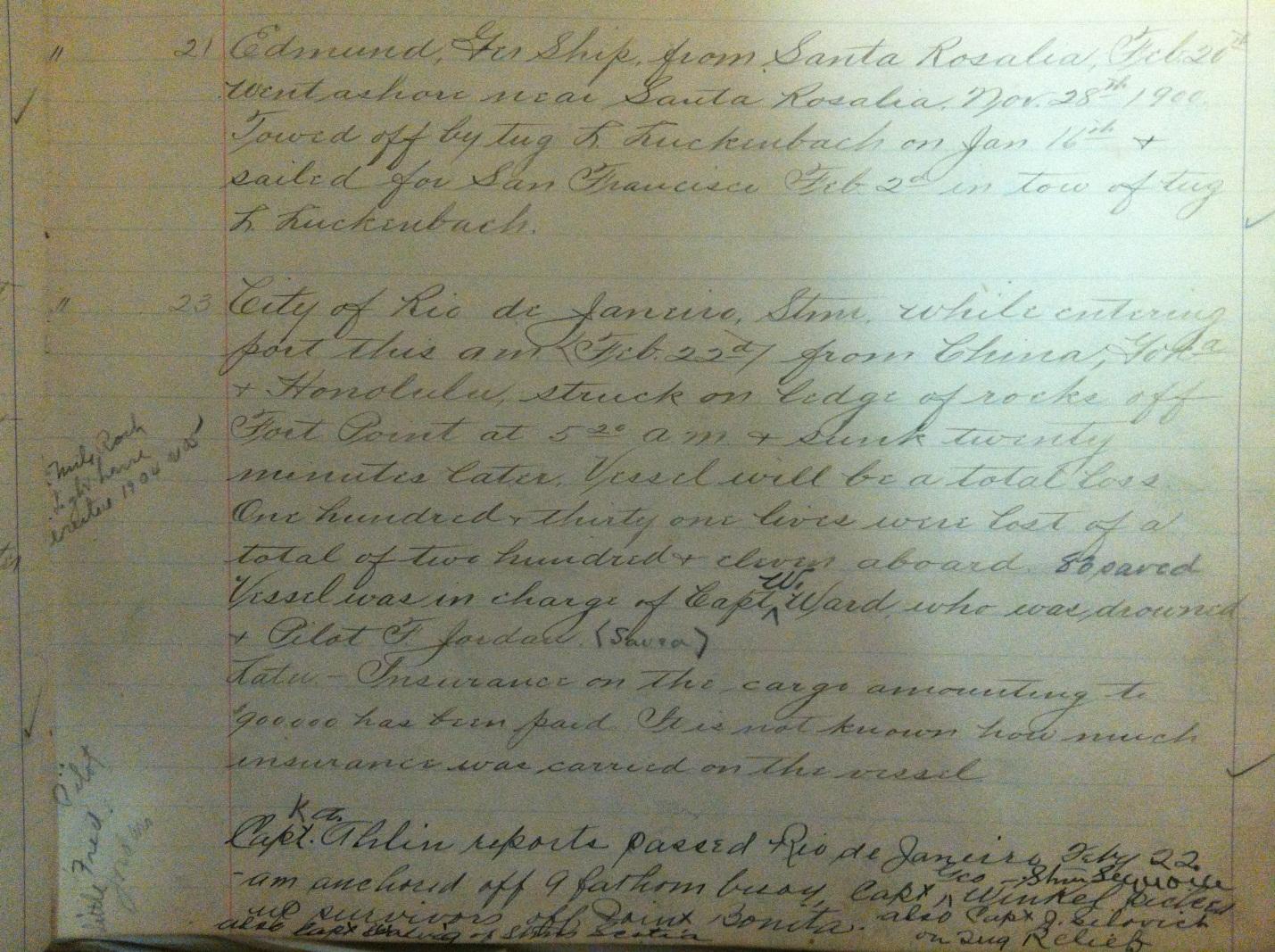
The Disaster and Mishaps and Total Losses ledgers are similar. Arranged by date, they list occurrences of cargos burned, masts snapped and crews lost with no traces to be found.  Some are detailed and seem to be retelling of Captains accounts, others are just a line or two.  Below is the entry from the Disaster log vol. 1 1900-1906 for the wreck of the City of Rio de Janeiro, a Pacific Mail steamer which hit a reef in San Francisco Bay.  131 people died. 


There is something for everyone in these records. It is my hope to have them all scanned and made available for researchers the world over.  Until then though, come to the library to see these unique records for yourself. 

The Marine Exchange Records (HDC 559 SAFR 18592) can be accessed in person by appointment. Some of the collection is available on microfilm and will be substituted for original material at the discretion of Collections Staff.  Please contact gina_bardi@nps.gov or call 415/561-7033. Scans or photocopies can be made as well at the discretion of the Collections Staff. Please see our Duplication Services for information on fees.

Tuesday, January 8, 2013

Overtaken

(by Heather Hernandez, Technical Services Librarian)

This week we're offering another instructive rhyme from Nautical Nursery Rhymes by Billy Ringbolt, which resides in the Peterson, Peter H. (Capt.) Papers, (SAFR 18665, HDC 571):

Overtaken

If a vessel astern of you closes at night,
Over the taffrail you show her a light;
Or a "flare up" would do if you have it quite ready;
And mind you, don't yaw, and lookout you steer steady.

Wednesday, January 2, 2013

Francis Bacon on words and ships

(by Heather Hernandez, Technical Services Librarian)

An upcoming release of Koha, the software that powers our Keys Catalog of Library Materials, will include a feature to display a quote of the day on the catalog. In preparation, we're collecting maritime quotes, reading quotes, and especially maritime quotes about reading--please send us your favorites!

This one struck me as one to share right away:

So that if the invention of the ship was thought so noble, which carrieth riches and commodities from place to place, and consociateth the most remote regions in participation of their fruits, how much more are letters to be magnified, which as ships pass through the vast seas of time, and make ages so distant to participate of the wisdom, illuminations, and inventions, the one of the other?
From the Project Gutenberg edition, available online in multiple formats, of The Advancement of Learning, by Francis Bacon.

Tuesday, November 13, 2012

Pulp treasure: The Grain Ships

(by Heather Hernandez, Technical Services Librarian)

The Library is fortunate to have a significant holdings of maritime pulp fiction.  These materials, vastly popular when published, are now often scarce due to the materials used in their manufacture: inexpensive papers that are highly acidic, known as "pulp."

Our holdings have currently been enriched through a large number of pulp magazines dating from the late 19th through the 20th centuries, donated as part of the Krummes Collection of Steamship Fiction.  Although we are mourning the recent passing of Dan Krummes, we are proud to preserve and make available these materials that created a love of the sea in so many.

We are cataloging the stories in the pulp magazines individually to make them more accessible;  if you're not able to come in to read them in person, simply contact us to obtain copies.

While cataloging the contents of vol. 3, no. 2 (Nov. 20, 1922) of Sea Stories Magazine, I came across the poem, "The Grain Ships" by Captain Dingle.  It was too good not to digitize as part of our pilot program to digitize library materials--it is now available in multiple formats via the Internet Archive and NPS Focus, and I am delighted to present here this charming poem about San Francisco's grain ships:

Image of The Grain Ships


Tuesday, October 16, 2012

Digging for Gold at the Library: U.S. Coast Survey Report

(by Gina Bardi, Reference Librarian)


I often talk about how walking through the stacks of the library I find gems based on unusual titles or interesting bindings.  Today’s gem has neither of these.  The binding is standard blue library binding and the title, U.S. Coast Survey Report is about as thrilling as a cotton ball. However, I walk past these volumes (it’s a continuing resource which is fancy library talk for “they publish it in volumes” [or maybe that’s fancy librarian talk for continuing resource…which is more fancy?!]) and a few months ago I stopped to take some off the shelf and see exactly what they were and what information they contained.   U.S. Coast Survey Reports are yearly reports from the Superintendent of the Coast Survey to Congress. For the most part, they have coastal maps, charts, tide tables, lists of maps completed or in progress and reports from various field offices which include shore line measurements, soundings, tidal observations, etc. There are also many appendices which give information such as who are the people doing the surveys in each area and a heaping dose of  math Math MATH! So much math!


 These reports are incredible resources for people who want to do in depth coastal research.  As I was flipping through the pages of the 1858 volume, however, I came across an appendix which popped out at me – it wasn’t the more dry scientific measurements, rather it’s statistics about shipping in and out of San Francisco.

The appendix (no.44) entitled “Directory for the Pacific Coast of the United States” is chock full of information which crosses all sorts of information needs.  The appendix is actually an extended report 8 years in the making on San Francisco Bay and port activity.  It has such bits of information such as in the year 1857, 1,328 vessels entered San Francisco from other American ports, 130 that entered were American vessels from foreign ports and 125 were foreign vessels from foreign ports making a total of 1,583 vessels that came to San Francisco that year (349).   Also according to the appendix, “At the end of the fiscal year , June 30, 1855, there were registered, enrolled, and licensed, at the custom-house of San Francisco, owned wholly or in part by citizens of California, 702 steam and sailing vessels engaged in trade upon the Pacific” (348).  The breakdown of that number is as follows: 


There’s more information in this wonderful resource including the average amount of gold shipped out of the state (351), value of exports of California for a three year period (350) and clipper passages times from 1850-1857 (346).

If any of these tidbits excite you, then stop on by the library and check out our U.S. Coast Survey Reports.

Source:
U.S. Coast and Geodetic Survey. Report of the Superintendent of the Coast Survey, Showing the Progress of the Survey During the year 1858. Washington: William A. Harris, Printer, 1859.

Tuesday, September 25, 2012

Sailing Vessels

(by Heather Hernandez, Technical Services Librarian) 

This week we're offering another instructive rhyme from Nautical Nursery Rhymes by Billy Ringbolt, which resides in the Peterson, Peter H. (Capt.) Papers, (SAFR 18665, HDC 571):

Sailing Vessels

A sailing ship when under sail,
Or being towed must never fail
Her side lights to let others see,
As told by Regulation Three;,
And also, as we all should know,
A masthead light must never show.

Wednesday, August 29, 2012

A Gold Rush Journal 'Round the Horn : Wildlife, Wind and Rum

Wildlife, wind and rum: sketches and observations after 2 ½ months at sea in 1849.


(by Palma J. You, Archives Technician)


After a stop on Saint Catherine, known today as Santa Catarina, the bark Croton sailed southward towards "Pattigonia on Terra del Fuego" April 3, 1849.  Mr. Chittenden notes "the streights are 15 miles wide & 50 miles long[…]mountains are high with snow upon the tops… land looks high & naked" [...].  There is "very little wood on bushes […] scattered here and thair like the western prairies." "The tide make 85 ft., Stattenland is about 30 x 7 miles. It is high and mountainous."


Mr. Chittenden writes there are "pleanty of seal & many foxes wolves tigers & the polar bair[…] large birds, the Albetrofs Petral Cape Pigion chicks Boobies Ostrich & others to numerous to mention." His sketch below is a view of the "Streights of Lamaire."


April 9th the bark Croton weathers Cape Horn:


"At 12 oclock the wind is increased to a gale, Sun obscured, Topsails reefed close, Ship laid to. It rains & hails, weather cold. Our correct position is not to be had this day. Our course is west by north of the wind […] we shall try & rum off before it."


"This cut represents the Bark Croton as she lay to in a gale off Cape Horn April 9th, 1849."

Earlier ‘Round the Horn journal entries feature a Receipt for Cholera, St. Michael and Saint Catherine.