Showing posts with label photographs. Show all posts

Tuesday, May 20, 2014

Maritime Metaphors: Collecting Memories

(by Lisbit Bailey, Archivist and Pop Music Aficionado)

This edition of Maritime Metaphors is about collecting memories.  The song lyrics to Bookends by Paul Simon conjure treasures of the past, the halcyon days perhaps.  Photographs are the iconic form of "memory," but we collect many other things to remind us of shared experiences of all kinds.

What do you collect?  What are the stories you tell?


Bookends

Time it was
And what a time it was, it was
A time of innocence
A time of confidences

Long ago it must be
I have a photograph
Preserve your memories
They're all that's left you

Check out the YouTube video of Simon & Garfunkel performing Old Friends and Bookends in medley, 1977.

Here is a variety of items selected from the Collections at San Francisco Maritime NHP evocative of the past, memories, and souvenirs.  Enjoy!


Photograph: This portrait of the Rasmussen family is a shipboard souvenir with hand coloring. Shown are Captain Rasmussen, his wife and children arriving in Honolulu aboard a Matson Lines vessel, taken between 1925 and 1935. (SAFR 22239, P09-011)


Bookmarks: These hand-painted lanceolate-type leaves are from an unidentified plant from Cape Town.
(SAFR 8680)


Christening Bottle: This square-section short-necked bottle is wrapped with blue and gold ribbons.  Inscribed on a brass plaque:  "Presented to SALLY ZUCKERMAN, sponsor / Rechristening S.S. HAWAIIAN MOTORIST / Honolulu, November 7, 1962." This vessel was originally a freighter built in 1945. It was rebuilt as a containership in 1960-61. (SAFR 20573)


Souvenir Handkerchief:  This item commemorates the Great White Fleet visitation to California in 1908. There is a starboard view of the flagship Connecticut at center and portraits of President Roosevelt above and Rear Admiral Evans below. (SAFR 17014)


Uniform Hat: An Officer of Matson Navigation Company wore this cap. (SAFR 19825)


This is a menu for the Aquatic Park Casino, circa 1940. (SAFR 15567)


Cocktail Napkin: This is a souvenir of Fisherman's Wharf, San Francisco, California, with drawings of the Golden Hinde (II) and Balclutha, circa 1970. (SAFR 19933)


Pillowcase:  Made of pink fabric with fringe and printed in blue. There is a spread-eagle symbol, a picture of a liberty ship and the legend "Souvenir of Kaiser Ship Yards, Richmond, Calif., Liberty Ships, Victory by Production,” circa 1943-1945. (SAFR 19364)


Postcard: This is a First Day Cover commemorating Drake’s vessel the GOLDEN HIND, 1580. (SAFR 15568)


Souvenir Program: Liberty Ship JIM OTIS was launched from Richmond Shipbuilding Corporation, Richmond, California, on December 31, 1941. (SAFR  17005)


Purse: A small purse or etui made from a coconut shell with hand-painted decoration, undated. (SAFR 3394)


Photograph: This is one photo from the William A. Dougan collection of albums and loose prints dating from 1916 to 1935.  Dougan, a Chief Engineer compiled the albums, included family, and voyage photographs aboard the steamer Roanoke. (SAFR 22304, P92-083)

Tuesday, March 4, 2014

Exhibit: Women Who Changed Maritime History

(by Heather Hernandez, Technical Services Librarian)

Captain and Mrs. G. T. Peterson aboard C. A. Thayer, San Pedro Harbor (near Los Angeles, CA), December, 1905.
NPS, SAFR D9.7883n
During the month of March, the Park is celebrating Women's History Month with many programs and a special exhibit in the Visitor's Center, "Women Who Changed Maritime History."  High quality selections from the Park's photographic collections illustrate maritime women throughout history, in this free exhibit, open seven days a week.

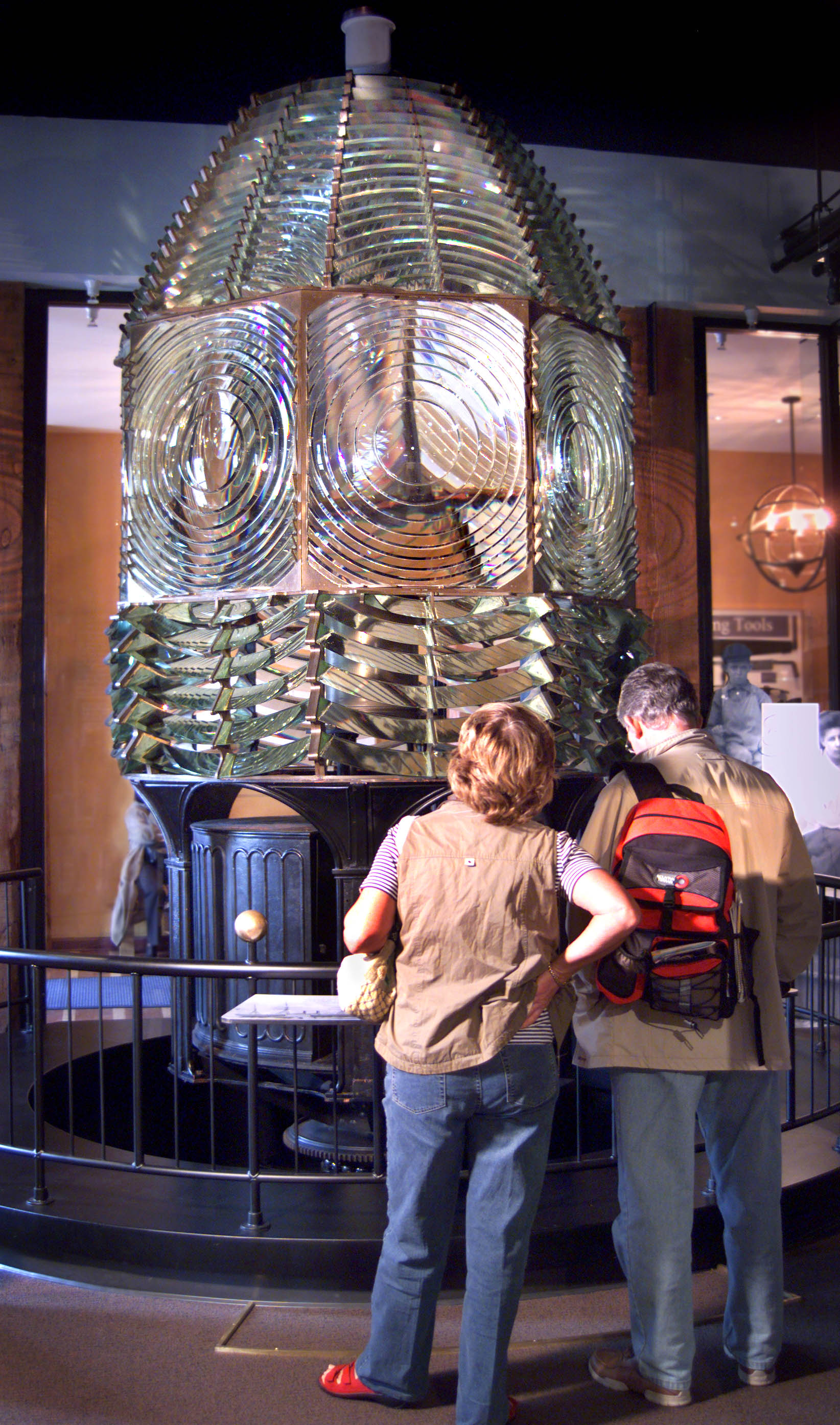
While you're there, explore the permanent Waterfront Exhibit where you can see many of the Park's artifacts on display as well as seeing our beautiful first order Fresnel lighthouse lens.  For more free fun, ask the helpful staff at the desk to give you directions to the Aquatic Park Bathhouse Building--our Maritime Museum--where even more of our collections are on display.  Take the time for a walk on the Hyde Street Pier as well, to see the ships, on which many of these women made history.

Tuesday, May 28, 2013

Photo Archives Spotlight: Definitive Men of the San Francisco Bay

(M. Crawford, Processing Archivist)
The waters of the San Francisco Bay have made many sea captains; men and women have begun their careers traversing the Bay, up and down the coast, and up into the rivers and deltas inland. Some of the recently processed collections in the Historic Documents Department tell the stories of some of these men--at the helm of tugboats, Monterey clippers, and sailboats. Although the collections may not seem to have much in common upon first glance, when you take a closer look at the lives they document, you will find that these men lived by the sea, made a living from the sea, and in the case of one captain, died at sea.


A web link to the Jack Ehrhorn collection of Stone Boat Yard photographs guide with more information about this collection including content, arrangement, histories and access.
Click for Collection Guide
Jack Ehrhorn collection of Stone Boat Yard photographs, circa 1885-2005. P05-081 (SAFR 23147)

Original black-and-white photographic print, 8 x 10 inches. Close-up of Jack Ehrhorn taken from a group photograph. He is standing next to an unidentified wooden-hulled boat under construction (likely St. Francis V (built 1973; sloop: yacht: 6 meter)). His right arm is up on the vessel; he is wearing white and a dark skully stocking cap. He is smiling, facing the camera. The photograph was taken at Stone Boat Yard, Alameda, California, circa 1973.
Decorated U.S. Army Platoon Sergeant, Jack Ehrhorn, was
entrusted with the photographs and textual materials from
the Stone Boat Yard. (P05-081, Ser.7.3, File 1, Item 923) 
Jack Ehrhorn was a life-long yachtsman, master shipwright, designer, draftsman and operations foreman. He started working for Lester Stone at the W.F. Stone & Son boatyard in 1941, where he helped build minesweepers for WWII. The Stone Boat Yard was a San Francisco Bay Area boat building company that was located in Alameda, California, from 1971-2004. The business had three previous names, and has been in four other locations in the San Francisco Bay Area since its establishment in San Francisco by W.I. Stone in 1853. It was run by three generations of Stones from 1853 until 1970 (W.I. Stone, W.F. Stone, and Lester Stone). It was one of the oldest and longest running businesses on the Pacific Coast and its boats and designs were very influential in Pacific Coast maritime history.

Black-and-white photographic print, 8 x 10 inches. The hull of St. Francis V (built 1973; sloop: yacht: 6 meter) is seen under construction, propped on blocks in a boat shop at Stone Boat Yard, Alameda, California, circa 1972-1973. View off port bow, three men are standing off port quarter with their backs to the camera. One of the men is wearing white overalls, which was characteristic of Jack Ehrhorn. Eight strips of planking are stem to stern over the ribs of the frame; planks are extending above the hull as well.
Ehrhorn helped build fast boats that won races, whether it was
his Yankee One Design  Flame, or the 6 Meter St. Francis V,
seen here in 1972. (P05-081, Ser. 6, File 5, Item 379)
One of Stone Boat Yard's specialties was producing first class yachts--the fastest on the bay some say. Ehrhorn worked on the constructing many of these beauties. In 1949, Lester even gave him a corner to build a yacht for himself, a Starling Burgess Yankee One Design, Number 34. Even in the 1970s, he was working on a 6 Metre St. Francis V designed by Gary Mull that won the 1973 World Cup in Seattle. Ehrhorn came to be the custodian of documents, photographs, photo albums and marine architecture drawings from the boat yard, all of which his estate donated to San Francisco Maritime National Historical Park in 2005. In this collection, there are over nine hundred photographs depicting vessels being built from start to finish, the details of construction, the tools and shop that they were built in, and the people that crafted these vessels. Combined with his collection of Stone Boat Yard records and marine architectural drawings (SAFR 21341, HDC 1288), we are able to see some of these boats come alive from their original drawings to yachts under sail.

A web link to the Captain Curt Hasenpusch photograph collection guide with more information about this collection including content, arrangement, histories and access.
Click for Collection Guide
Original black-and-white photographic print, 3.5 x 5.75 inches. Close-up of Vici Hasenpusch (left) standing on board an unidentified vessel, eating a cookie. Her forehead is bandaged after falling off a horse at Golden Gate Park. Her father, Captain Curt Hasenpusch stands to her left, with a plate in his hands. There is an unidentified woman in the background. What appears to be the Golden Gate Bridge is visible in the background. The occasion for being onboard was a picnic for crew and families. 1951-04-22
Domestic life was not
limited to land. The
captain and daughter,
Vici, on the bay.
P07-005 Ser. 4 File 3
Item 211.
Captain Curt Hasenpusch photograph collection, circa 1900-1960s. P07-005 (SAFR 23352)

Captain Curt August Hasenpusch (1910-1962), a first generation San Franciscan, was a boatman on the San Francisco Bay from the early 1930s until his death. His employers included Anderson's Shipyard and Crowley's Red Stack tugs, both eminent companies in Bay Area maritime history. He worked on everything from the pilot boat California to the tugboats Crowley No. 23 and Frank G. White during his career. Born in San Francisco on March 12, 1910, he was the second son of German immigrants who arrived just before the Great Earthquake and Fire. He was a collector of maritime photographs and memorabilia, as well as a model boat builder, one of which, the 1893 pilot boat Gracie S (SAFR 22765) is in our museum collection.

Black-and-white photographic print, 3.5 x 4.25 inches. Looking fore to aft along the deck of one tug, the photograph is of another tugboat alongside a listing vessel that has smoke rolling off the starboard deck. The San Francisco-Oakland Bay Bridge is in the background. Circa 1940s-1950s
Hasenpusch spent his life working the Bay
with many photos taken from those decks.
(P05-007, Ser.1.1, File 1, Item 52) 


His collection consists of mostly photographic prints, some of which hung in his family's home. Within the boxes, folders, and envelopes you will find photographs of tugboats, pilot boats and other vessels, all predominantly in the San Francisco Bay, from the 1900s to the 1960s. There are photographs of vessels under construction, being launched, at dock and underway; shipwrecks; and maritime activity, events and people in the San Francisco Bay.

The collection includes images of the tugboat Crowley No. 23 which Hasenpusch was a captain on from 1945-1951; the pilot schooner California on which Hasenpusch worked as an engineer; and the tugboat and auxiliary fireboat Frank G. White.

This deck's-eye view giving witness to an account of life on the Bay waters is a compelling perspective for landlubbers and mariners alike. The auxiliary fireboat was the last vessel that Captain Hasenpusch worked on, for on June 12, 1962, the captain suffered a fatal heart attack while on duty in her wheelhouse and died at the calling he so dearly loved.

A web link to the James L. Douthit photographs and oral histories guide with more information about this collection including content, arrangement, histories and access.
Click for Collection Guide
James L. Douthit photographs and oral histories, circa 1965-1975, 1989. P91-058 (SAFR 22588)


Black-and-white photographic print. An unidentified man is standing and looking down, baiting lines on the foredeck of a boat which appears to be at dock. He is wearing overalls, a shirt, and a longshoreman's or flat-type cap. There is a pile of lines in front of him, baited and ready, the lines wrapped in a circle and the fish hanging off the hooks at the edge of the circle. Circa 1965-1975.
Hours fishermen spent were
not all out on open water.
The preparation and dedication
of those that chose this trade
are evident above.
(P91-058 Ser 1.1 Vol 2 Item 74)
James L. Douthit was a photographer and a reporter from the Pacific Northwest and spent many years writing for the Oakland Tribune. He was also a maritime historian; he wrote articles on whaling and conducted oral histories of people involved with fishing vessels and steam schooners in California and Oregon.

This collection contains photographs of Monterey clipper fishing boats, fishermen and the fishing trade, and boat shops, taken circa 1965-1975 as a part of Douthit’s research. The majority of the photographs are of vessels, some with operators on board. Some photographs depict on-deck scenes of fishing or fishing equipment: portraits of fishermen, views of preparing lines, hauling in fish, and weighing fish on the dock. Photographs include the “Yukon Gang,” a notorious group of fishermen that worked together from the 1950s-1970s. The collection also includes transcripts of interviews with Monterey clipper boat builders and fishermen, as well as portraits of some of the interviewees. These men are important figures in maritime history, captaining vessels which defined the fishing industry in the San Francisco Bay for decades and characterized Fisherman’s Wharf.

Small in stature, these Monterey clippers were a big presence in the San Francisco Bay. They were introduced to the San Francisco Bay around 1925. The boats and their captains played a key role in the local 1930s sardine industry. It wasn’t until the 1950s, as the fishing industry hit its peak and began to decline, that the Monterey clippers began to disappear (P91-058, Ser.1.1, Vol. 2, Item 14)
Surely, these men lived very different lives, but the waters of the San Francisco Bay kept them closely connected. Perhaps they knew one another, if even in passing. Perhaps they crossed paths on the waters of the San Francisco Bay. I will most likely never know but I will spend a good amount of time in speculation... If you would like to find out more about these men, their livelihoods, and their accomplishments, peruse the collection guides on the Online Archive of California or make an appointment with our resourceful reference staff to assist you in your quest for more.

Tuesday, March 26, 2013

Photo Archives Spotlight: A River Tyne Paddle Tug Arrives in San Francisco

(By M. Crawford, Processing Archivist)
Two recently processed collections (cue Simon and Garfunkel’s Bridge over Troubled Water) will take you back to March 24, 1970, and a British Invasion of the nautical kind. The George R. Lamuth photographs and the H. Alan Sims photographs of the Eppleton Hall (built 1914; tugboat) are collections of 28 and 56 slides, respectively, documenting the approach, celebration, and new home of Eppleton Hall in San Francisco.

Color slide, 2 x 2 inches. Photographed by George R. Lamuth. Eppleton Hall (built 1914; tugboat) is flanked by a fire boat spraying water, and three other vessels as she steams in the San Francisco Bay towards Fisherman’s Wharf after a six month and 10,000 mile voyage from Newcastle-upon-Tyne, England, to San Francisco, California.
Fireboats and spectators welcome Eppleton Hall as she makes her way
Fisherman’s Wharf. Photo by George R. Lamuth. (P99-015, Item 7)

A web link to the George R. Lamuth photographs of the Eppleton Hall (built 1914; tugboat) guide with more information about this collection including content, arrangement, histories and access.
Click for Collection Guide

George R. Lamuth photographs of the Eppleton Hall (built 1914; tugboat), 1970 March-1989 September, P99-015 (SAFR 23143)


A web link to the H. Alan Sims photographs of the Eppleton Hall (built 1914; tugboat) guide with more information about this collection including content, arrangement, histories and access.
Click for Collection Guide
H. Alan Sims photographs of the Eppleton Hall (built 1914; tugboat), circa 1950s, 1970 March 24, P99-014 (SAFR 22590)


Color slide, 2 x 2 inches. Photographed by H. Alan Sims. A sign lettered with calligraphy giving the details of the journey of Eppleton Hall (built 1914; tugboat): “This Steam Paddle-Tug is the last one in the world. She sailed 10,000 miles - Newcastle-upon-Tyne, England to San Francisco, California. The voyage took 6 months and 1 week, through 3 severe storms, entirely under her own power, with a San Francisco crew.”
An epic journey it was!
As if this wasn't dramatic enough, add to the plot three 
children aboard for the journey, illness in Mexico, and some 
colorful disagreement about the way to run a ship, and you 
have yourself an adventure. Photographed by H. Alan Sims.
(P99-014, Item 4)

You will have to bring your own band, but you can still experience the crowds, camera crews, and first glances of this relic as she steams into San Francisco. The measures taken to pull the burned-out hull of this steam side-wheeler out of the mud and return her to full operation were tremendous--a labor of love, indeed--and her arrival from Newcastle, England, was a day of exuberance. H. Alan Sims, of the Sacramento Area, and George Lamuth, life-long San Franciscan, were there to capture it on film for all of us that couldn't be there and for all of us who choose to relive it.


Color slide, 2 x 2 inches. Photographed by H. Alan Sims. Closeup of the builder’s plate that was installed on the vessel upon her 1969 renovation.
Builder’s plate from the restoration of  Eppleton Hall.
William “Bill” Bartz, went to Newcastle with Karl Kortum 
and Scott Newhall to purchase the paddle tug. He stayed 
with her while she underwent her renovation in England, doing 
much of the work himself. Photographed by H. Alan Sims.
(P99-014, Item 38)

Peruse the collection guides on the Online Archive of California to explore more, or while you’re in the mood, make an appointment with our reference staff to see the collections in person. While you’re here, feel free to pull Captain Scott Newhall's book on the Eppleton Hall (Call No. G470 N4) off the public reference shelf, or request a look at the logbook of her journey to San Francisco (HDC 1137, SAFR 17686). There's more to be found; it's only a reference request away.

Wednesday, March 6, 2013

Photo Archives Spotlight: From Wooden Boats to Steel Hulls

(by Amy Croft and M. Crawford, Project Archivists)

Two newly processed collections at San Francisco Maritime represent the diverse talents of Northern California residents. From designing commercial vessels to building wooden boats by hand, these creators reflect the difference in the scale of maritime craft and the different processes of building boats and ships.

Online Archives of California link to the William H. Grunwald photographs collection guide.
Click for Collection Guide

William H. Grunwald photographs, circa 1960-1997. Collection No. P99-007 (SAFR 19671)

Image: black-and-white photographic print. Detail of photograph of Aeolus Boats logo burned into wood.
Aeolus Boats logo burned into wood.
(P99-007, Ser. 1, File 1, Item 1.1)
If your interests are in wooden boats and small craft and you don't know about Aeolus Boats in Davenport, California, you'll probably want to. The William H. Grunwald photographs (SAFR 19671, P99-007) come from the owner of Aeolus Boats and  builder of fine craft himself, and were recently processed and made available for research by the Historic Documents Department.
Image: 3.5 x 5 inch, color photographic print. Grunwald is standing next to a boat he is framing. He has a saw in his hand and is looking at the camera.
Bill at work in his boatshop.
(P99-007, Ser. 1, File 2, Item 18.3)

Over the course of his 40 year career building boats, Bill Grunwald, became a prominent and established boat builder in Northern California. Born in Seattle and raised in Alameda, Grunwald bought a barn in Davenport and began Aeolus Boats in the 1950s. He first built sailboats; later concentrating his efforts on custom boats. He used about 26 designs for rowing boats, punts, dories, and yacht tenders.

The photos date from around 1960 to 1997 and depict mainly boats built by Grunwald. They are shown being constructed, out and about on various San Francisco Bay Area waters, and they are often occupied or surrounded by people enjoying themselves. Awaiting your discovery are photographs from photo essays, prospective and satisfied customers, as well as Grunwald's personal collection, making up three photo albums and 124 loose photoprints. Take a look to view the construction of the boat hulls, the boat shop itself, and a master at work (and sometimes at leisure.)


Image: 3.5 x 5 inch, color photographic print. Keel and hull view of a boat on blocks, under construction, at Grunwald's Aeolus Boat Shop.
Grunwald’s shop with his boats under construction. (P99-007, Ser. 1, File 3, Item 3.2)

Online Archives of California link to the L. Christian Norgaard photographs collection guide.
Click for Collection Guide

L. Christian Norgaard photographs, circa 1954-1985. Collection No. P95-035 (SAFR 22581) 


Black-and-white photographic print, 8 x 10 inches. Norgaard is standing on gangplank of the vessel. He is on the left. There is one woman and a man next to him on the stairs. Three men are standing below on the dock. The men are all wearing suits, some wearing hats. The Mokuhana name is seen painted on the vessel in the background.
Norgaard, upper left, celebrates
delivery of Mokuhana.
(P95-035, Ser 1, File 1, Item 4.1)
These photographs are from the prodigious work of local naval architect and marine engineer, "Chris" Norgaard. Chris was a longtime resident of the San Francisco Bay Area and Sacramento, California. His career spanned from the design of small craft and large cargo vessels to the design of replicas and historic ship renovations. He was responsible for the design of over 400 vessels seen from Los Angeles, California, to the fisheries and canneries of Alaska. He designed the cargo vessels Mokuhana and Komoku for Bay and River Navigation Company to transport sugar from the C & H Sugar Refinery at Crockett, California, to distribution points across San Francisco Bay including C & H’s headquarters at the city’s now historic landmark Pier One. Norgaard is perhaps best known for his designs of the replica of Sir Francis Drake's flagship Golden Hinde, Western Pacific's train ferry Las Plumas and the Red and White Fleet of sightseeing boats on San Francisco Bay during the fifties, sixties and seventies. He also worked on restorations of famous vessels, such as President Roosevelt's yacht Potomac.

Black-and-white photographic print, 8 x 10 inches. A young blonde girl in shorts and long sleeves stands in front of the Kort Nozzle propeller of an unidentified tug as it sits in dry dock. This photograph is from the album, Tugs--Designs by L. Chris Norgaard--Vol. 1.
Girl inside of kort nozzle on unidentified tug.
(P95-035, Ser 1, File 3, Item 2.26)
Notably, Norgaard was responsible for numerous maritime engineering innovations, such as the adoption, development and design of the "Kort Nozzle" on U.S. West Coast vessels.  He also authored and compiled a number of technical papers and books, including Golden Hinde II: A Galleon, c1570 (1974).

The collection holds 15 photo albums, loose photographs, and loose album pages (2.4 linear feet) documenting tugboats, cargo, passenger, public, and fishing vessels that he worked on from the 1950s to the 1970s. Many photographs depict the construction and christening of new vessels as well as exterior views of vessels at work. In addition, you will find Norgaard’s personal papers and over 1,300 vessel plans in the Loring Christian Norgaard historic documents collection, HDC 1294.


Black-and-white photographic print mounted on paper, 8 x 10 inches. The vessel is underway with full sail. Norgaard designed and oversaw the construction of this replica of the original GOLDEN HINDE, from 1971-1973.
Golden Hinde II
(P95-035, Ser 1, File 4, Item 1.2)
Make an appointment to take a closer look at the art of wooden boat building and ship design through these photographs -- some of them may document some vessels you may have seen with your own eyes cruising San Francisco Bay waters. Peruse the collection guides on the Online Archive of California to explore more on your own or contact our reference staff to guide you.

Tuesday, July 10, 2012

Collection spotlight: Ron Cleveland Photograph Collection


(Written by M. Crawford and Amy Croft)

The Ron Cleveland photograph collection (P90-062, SAFR-22583) was recently processed at the San Francisco Maritime National Historical Park (SFMNHP) and contains photographs of the construction of ship models built by Ron Cleveland from 1965-1984. One of the models he built was of the KOHALA, a California-built barkentine that played a role in the West Coast lumber and sugar trades during the early 20th century. The model is a product not only of his interest in maritime history but also the result of in-depth archival research.
Ron Cleveland (1912-1987) was a California architect who had a strong interest in maritime history and the construction of 19th century sailing vessels. Ron's interest in maritime history started because his grandfather worked on spritsail barges on the Thames River in England in the late 19th century. Ron's first ship model was of the English spritsail barge KATHLEEN and his second model was of the Norwegian brigantine LEON. In his professional life, Ron worked as a principal architect at Leach, Cleveland and Associates for 36 years, specializing in the design of over 100 Southern California supermarkets. The firm designed some permanent exhibits at the Los Angeles Museum of Science and Industry and was retained in 1968 by the California Museum Foundation as consultants for, and designers of the exhibit "The Queen Mary Story" as part of Jacques Cousteau's Museum of the Sea, on board the QUEEN MARY while she was a museum ship in Long Beach.

Cleveland did extensive research using archival and library resources to ascertain the specifications of the vessels that he created, in order to build them to scale as accurately as possible.  Ron also consulted with other maritime historians and people who had worked or sailed on similar vessels in the past, particularly to ensure that he built the structure and rigging correctly. For example, he interviewed Harlan Gow, who worked as a shipwright in the Bendixen shipyard from 1898-1908, about how they had built the West Coast vessels. Cleveland also interviewed Lester Stone, whose grandfather built one of the first shipyards in San Francisco in 1853, and who later took over the shipyard. Both of these interviews are now in the San Francisco Maritime's collections. Cleveland also relied on the assistance and knowledge of Robert "Bob" Weinstein, Captain Fred Klebingat, and San Francisco Maritime Museum Founder and Chief Curator Karl Kortum. Ron joined the Nautical Research Guild in 1964 and later began a Southern California Chapter with the assistance of Bob Weinstein.
In 1969, Ron began construction of a model of the barkentine KOHALA, which took him nearly 15 years to complete. During this time he wrote a manuscript titled "Rigging of West Coast Barkentines and Schooners" which has details about the construction of his model of the KOHALA. According to Ron, Karl Kortum told him that no one to his knowledge had pursued the study of structure and rigging of West Coast barkentines to the extent that Cleveland had over this 15 year period.
The KOHALA was a four-masted barkentine that was built at Fairhaven, California in 1901 by the Bendixsen Shipbuilding Co. for the management of Hind, Rolph & Co., San Francisco and was first primarily used in the West Coast lumber trade. Later she established herself in the sugar trade on a cargo route to Hawaii from San Francisco, and is named after the North Shore and volcano of the Big Island itself. Her last sail passage was in 1921 and she was later turned into a fishing barge. On December 25, 1941 the KOHALA was mistaken for a possible Japanese submarine and accidentally sunk by American bombers near Redondo Beach!
In 1985, Mr. Cleveland donated the KOHALA model to San Francisco Maritime NHP. The model of the KOHALA is on display in the San Francisco Maritime Museum at 900 Beach Street - come check it out! In addition to this model of a vessel that played a role in 20th century maritime history and commerce, Ron's extensive research and notes are a valuable resource about how the KOHALA was constructed and can be found in his manuscript collection, also held here at the San Francisco Maritime NHP (HDC 1061, SAFR 12782). Although the age of sail has past, Ron's model of the KOHALA literally and figuratively preserves a small piece of that history with remarkable accuracy.

Check out the finding aid on the Online Archive of California to learn more about the nearly 3000 photographs in the Ron Cleveland photograph collection! Some of the photographs have been scanned and can be viewed on NPS Focus (http://npsfocus.nps.gov/npshome.do?searchtype=npshome) by searching for "Ron Cleveland Photographs".
 
Quote: "If I could shrink my body to one-inch size I could walk up the gangway, go to the wheel house and sail her out to sea," said Captain Fred Klebingat in a Los Angeles Times article published on March 5, 1984. Ron Cleveland (left), Captain Fred Klebingat (right) and KOHALA model. Photograph courtesy of the SFMNHP, Series 1.1, File Unit 40, Item 01.

Quote: Ron constructed each of these figures by hand. According to Ted Miles, Reference Librarian at the San Francisco Maritime Library, most ship models do not have miniature people on them. Photograph courtesy of SFMNHP, Series 1.1, File Unit 43, Item 20.