Tuesday, July 9, 2013

Ships by John Masefield

(by Ted Miles, Assistant Reference Librarian)
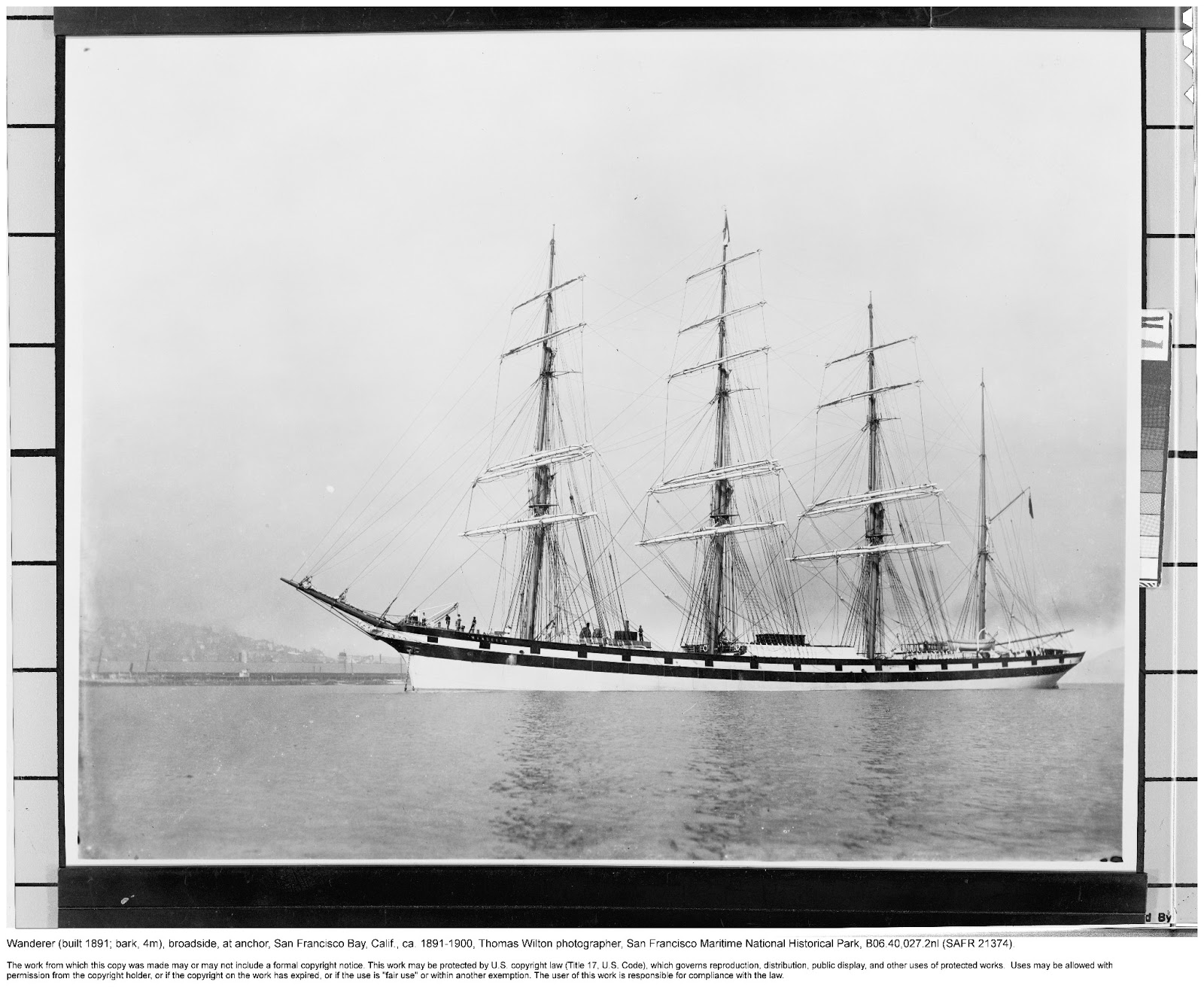
Black and white photo of vessel on the water
Wanderer of Liverpool at anchor in San Francisco Bay, circa July 1892.
Photo by Thomas H. Wilton (B6 40,027nl)

John Masefield  ( 1878-1967) started by joining the Training Ship Conway intending to be an officer in the British Merchant Navy at that time the largest in the world. After completing his schooling in 1894, he went to sea as an Apprentice in the Gilcruix (iron 4 mast ship, built 1883) and several other vessels; he had seen the famous and beautiful Wanderer (steel 4 mast bark, built 1890). He wrote a detailed biography of the vessel. But he had to abandon his sea career due to poor health. After a period of odd jobs he settled into a successful career of writing and lecturing in England and the United States.

But his early life at sea provided the creativity that produced Salt Water Ballads in 1902. And many of his sea poems also appeared in his Collected Poems in 1922 which sold over 80,000 copies.

The poem is a tribute to the Port of Liverpool and to the vast fleet of ocean going square riggers that once crowded its harbor and wet docks. From it comes:

Lochs, Counties, Shires, Drums, the countless lines
Whose house-flags were all once familiar signs
at high main-trucks on Mersey’s windy days
When sunlight made the wind-white water blaze.
Their names bring back old mornings, when the docks
Shone in their house-flags and their painted blocks,
Their raking masts below the Custom house
And all the marvelous beauty of their bows….
That nobleness and grandeur, all that beauty
Born of a manly life and bitter duty,
That splendor of fine bows which yet could stand
The shock of rollers never checked by land.
That art of masts, sail crowded, fit to break,
Yet stayed to strength and backstayed into rake,
the life demanded by that art, the keen
Eye-puckered, hard-case seamen, silent lean,--
They are grander things than all the art of towns,
Their tests are tempests and the sea that drowns,
They are my country’s line, her great art done
By strong brains laboring on the thought unwon,
They mark our passage as a race of men,
Earth shall not see such ships as these again.

This last couple of lines is the most often quoted of Masefield’s poetry. The poet became Poet Laureate of the United Kingdom in 1930 and was given an honorary doctorate from Cambridge University in 1931. That is a pretty successful effort for a boy who liked to read and expected to go to sea in a square-rigged sailing vessel.   

The Poems and Plays of John Masefield (Volume One Poems) by John Masefield, (New York: The MacMillan Company) 1922. Pages 68, 69, 70 and 71. 


Tuesday, July 2, 2013

Holiday hours this week

(by Heather Hernandez, Technical Services Librarian)

Update:  The Library will also be closing at 2:30 pm on Wednesday, July 3.

Reminder:  the Library will be closed for the federal holiday this Thursday, July 4 and also closed on Friday, July 5.  We will resume our normal hours on Monday, July 8, 3013.

Tuesday, June 25, 2013

Now online: Gems from Olivette

(by Heather Hernandez, Technical Services Librarian)

As part of the Library's pilot book digitization project, we've now digitized and made available a very rare musical score, Gems from Olivette by Edmond Audran:

Cover of the score, Gems from Olivette
Cover of Gems from Olivette

Available to read online or download in multiple formats (including .pdf, EPUB, Kindle, Daisy or plain text) on the Internet Archive, the high resolution page images are also available on NPS Focus.  The score contains songs from Olivette, which opened at the Bijou Theatre on December 25, 1880, with delightful titles such as "Jamaica rum : a grog-orian chant," "The  torpedo and the whale," and "Where balmy garlic scents the air," for voice with piano accompaniment.

As part of our pilot project, we've digitized several types of items: reports, illustrated books, poetry, and now a score, and made them all available on NPS Focus and the Internet Archive.  We hope to be able to begin digitizing more resources in the future!

Wednesday, June 19, 2013

Zigzag Journeys in Australia, or, A Story of a Cover

(by Heather Hernandez, Technical Services Librarian)

This charming cover for a book about travels in the seas around and in the land of Australia is now available online in the Keys Catalog and in the Open Library:

Cover of Hezekiah Butterworth's Zigzag Journeys in Australia
How does Keys get its covers?  Two ways:

If the work has an ISBN, then Keys will automatically pull a cover image from an Open Library record.  This is a feature of the Koha open-source catalog software that powers Keys, that's easily selected in the system administration.

But what about older works, such as this one, that predate the ISBN system?  First we check the Open Library record to see if a cover image is available.  If not, then we scan the cover, and upload it to Keys.  We also upload it to the Open Library so that it can be available to the world.

Uploading to Open Library is easy--you don't even have to log in!  No Open Library account is necessary, although accounts are free if you'd like one, and they allow you to improve the book descriptions.  To contribute covers, their system for adding covers just requires a couple of clicks to either upload an image from your computer, or paste in the address of a cover image from the web.  It's quick to do, and is an easy way to make wonderful aspects of books available to all!

Monday, June 17, 2013

Holiday hours, July 2013

(by Heather Hernandez, Technical Services Librarian)

The Library will be closed for the federal holiday on Thursday, July 4 and on Friday, July 5, resuming our normal hours on Monday, July 8, 3013.

Tuesday, June 11, 2013

Sailing Vessel in Fog

This week we're offering another instructive rhyme from Nautical Nursery Rhymes by Billy Ringbolt, which resides in the Peterson, Peter H. (Capt.) Papers, (SAFR 18665, HDC 571):

Sailing Vessel in Fog

When a ship is on the starboard tack, the fact you'll always know,
Because upon her fog horn a signal blast she'll blow;
And when upon the port tack the blast will then be two,
At frequent intervals the while the fog obscures the view;
And when you hear a triple blast, you'll know, that it would seem,
That the hidden craft is sailing with the wind abaft the beam.

Tuesday, June 4, 2013

Roast Filet of Beef du Barry

(by Heather Hernandez, Technical Services Librarian)

The next recipe in the Library's copy of The captain's table : 18 recipes for famous dishes served aboard the S.S. United States and S.S. America follows a portrait of Mr. Charles Gray, Hospitality Officer at Grosvenor House London which is captioned:
I have travelled [sic] many times, both on the S.S. United States and the S.S. America, and I have always had a most enjoyable trip with wonderful hospitality.  Each time I make a crossing, I insist on having Roast Filet of Beef du Barry.  The chefs on board roast filets to perfection.
The recipe for Roast Filet of Beef du Barry:
Wipe a filet of beef with a damp cloth.  Trim it neatly, remove all the connective tissue, and have it larded with narrow strips of larding pork.  Roast the filet in a very hot oven (450° F) for 8 minutes to the pound, basting it frequently with hot beef stock for the first 15 minutes and then with the pan juices, until it is done.  Remove the filet to a heatproof platter.  Surround the meat with bouquets of cooked cauliflowerets.  Coat the flowerets with Sauce Mornay (see recipe) and sprinkle the sauce with grated cheese.  Put the platter in a very hot oven (450° F) until the sauce is browned and bubbling.  A 5-pount filet serves 10 to 12.