Tuesday, March 4, 2014

Exhibit: Women Who Changed Maritime History

(by Heather Hernandez, Technical Services Librarian)

Captain and Mrs. G. T. Peterson aboard C. A. Thayer, San Pedro Harbor (near Los Angeles, CA), December, 1905.
NPS, SAFR D9.7883n
During the month of March, the Park is celebrating Women's History Month with many programs and a special exhibit in the Visitor's Center, "Women Who Changed Maritime History."  High quality selections from the Park's photographic collections illustrate maritime women throughout history, in this free exhibit, open seven days a week.

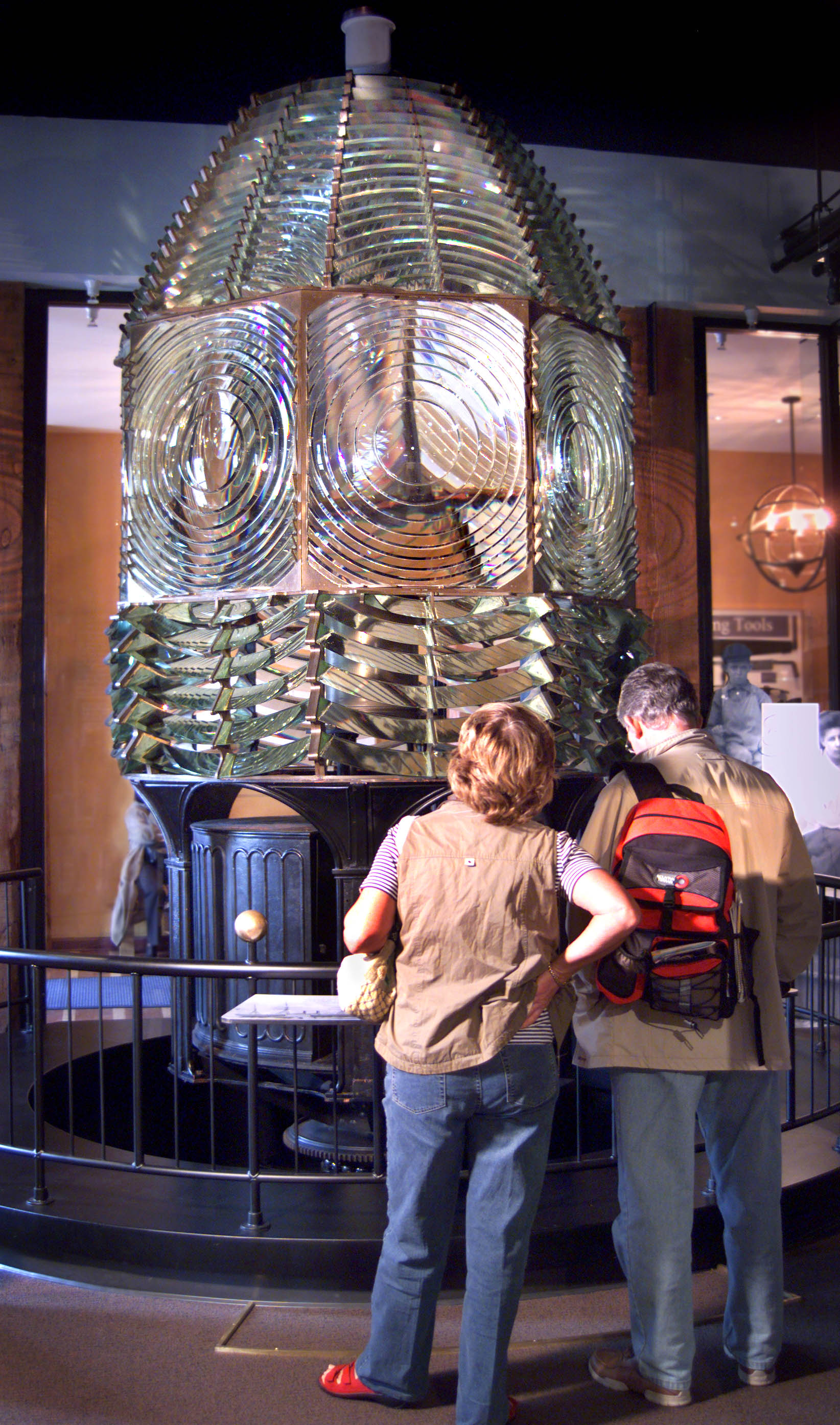
While you're there, explore the permanent Waterfront Exhibit where you can see many of the Park's artifacts on display as well as seeing our beautiful first order Fresnel lighthouse lens.  For more free fun, ask the helpful staff at the desk to give you directions to the Aquatic Park Bathhouse Building--our Maritime Museum--where even more of our collections are on display.  Take the time for a walk on the Hyde Street Pier as well, to see the ships, on which many of these women made history.

Tuesday, February 25, 2014

SF History Expo, Mar. 1-2, 2014

(by Heather Hernandez, Technical Services Librarian)

Page from the Pangburn journal, kept aboard the Nautilus (HDC 59)

Join us at the San Francisco History Expo this weekend!  Collections staff will be bringing real artifacts and many high quality reproductions of archival materials that you can see up close, creating one of more than fifty "mini-museums" at the Old Mint.  Don't miss seeing the working model of the Park's scow schooner Alma, and learning about Gold Rush ships.

If you're on Facebook, you can rsvp to our event--we hope we'll see you there!

Tuesday, February 18, 2014

Digging for Gold at the Library: Anthologies of Shipwrecks and Other Maritime Disasters

(by Gina Bardi, Reference Librarian)

As the winter finally descends upon San Francisco my thoughts turn to good books to cozy up with on a cold night (ok, East Coasters, be quiet. 50 degrees is winter to us!)

Tucked in a comfy chair with a blanket and a fire roaring, there are few better things to read than tales of shipwrecks and disasters.  Safe in the knowledge that I will soon fall asleep in a warm bed, I can let myself explore the terrible hardships encountered by those who brave the sea and too soon learn of her cruelty.
I went back to the shelves and picked 5 anthologies of shipwrecks and disasters for those of you who are fascinated by the tragic side of the sea. 3 of them I have read before and 2 are new to me. I hope you enjoy them safely and warmly in the new year.

1. Kingston, William Henry Giles. Shipwrecks and disasters at sea. New York: G. Routledge, 1873. Book. (Available in the Library and online in multiple formats.)

Kingston’s book is interesting because not only does it provide accounts of aforementioned shipwrecks and disasters, but it also attempts to be an ethnography and a natural history of places where the tales have happened.  For instance, in the chapter entitled “The wreck of the ‘Cabalva’ or the Adventures of Old Bo” there’s some very nice drawings and descriptions of the canoes of New Guinea (p. 483) .


In fact, this book has many charming illustrations. The one below caught my eye as I was flipping through. Perhaps it’s the Oliver like language.  (p. 374)


Or this one- the faces of the men are haunting  (p. 209).


Or this one of a bird colony- can’t you just these gulls a’sqwuakin’? (p. 283).


Most of the accounts tend to be first person narratives. However, they are not cited at all which would be frustrating if using this in any sort of academic way. For example, the chapter on the foundering of the Arctic, begins, “Some years ago I made a passage, in the month of September, on board one of the fine ships belonging to the Collins’ line of steamers, from Liverpool to New York.” Whoever this “I” is is never mentioned or addressed. It would be nice to know who our heroic survivor was.

2. Huntress, Keith. Narratives of Shipwrecks and Disasters. Ames: Iowa State University, 1974. Book.

As opposed to the Kingston book, this anthology strives to give background information on both the narrator and the event.  Context greatly helps and gives an added dimension to the account.  Huntress tells us, as an example, that the chapter on the brig Polly so impressed Edgar Allen Poe that he used it as a basis for his Narrative of Arthur Gordon Pym.  Having read Pym a few years back, I knew I was in for a harrowing account.  In fact, I would say this book really packs a punch more so than some of the others. I believe the author has done a particularly good job of selecting which narratives to use.  The book has an added bonus of including a “Checklist of narratives of shipwrecks and disasters” wherein Huntress lists works  in which “shipwrecks or other maritime disasters have been the primary concern” (p. 218).  There are a few hundred listed but he concedes that there are thousands he has not listed.

3. Lockhart, J.G. Peril of the sea: A book of shipwrecks and escapes. London: Philip Allan & Co. 1924. Book.

This collection differs from the previous two in that these are not solely first-hand accounts or narratives; Lockhart tells the story and mixes in first-hand accounts liberally.  This collection is interesting because it has a description of the sinking of the Titanic, something most of the anthologies I’ve come across shy away from, most likely because it is extensively covered in other sources.  There’s also an account of the sinking of the Birkenhead in 1852.  Anyone want to venture a guess as to what the wreck of the Birkenhead is famous for? (pause to give you a chance to think… no Googling!) It’s the first known time the practice of saving the women and children first was instituted.  Despite the fact that the frigate was well built and almost new there were not enough lifeboats on board.   Adding to the tragedy was that some of the already inadequate number of boats were either destroyed in the wreck or inaccessible because of it.  Of the 445 on board, 193 were saved, around 30 of which were all the women and children on board.  A male survivor is quoted as saying, “Thank God, it can seldom be said that Englishmen have left women and children to perish and saved their own lives!” (Lockhart 267).

4. Martingale, Hawser. Tales of the ocean and essays for the forecastle: containing matters and incidents humorous, pathetic, romantic and sentimental. Boston: B.B. Russell, 1874. Book.  (The 1840 edition is available online and in the Library.)

Ok, you caught me.  This one isn’t just about shipwrecks, but the title was so fetching to me I couldn’t resist pulling it off the shelf and checking it out. I was anxious to see  what all Mr. Martingale had collected for us under the categories listed in the subtitle.  Most of the contents of the book came from articles published in the Boston Mercantile Journal presumably written by the author.  Martingale states in his introduction  “Among the Tales which are here presented to the public, illustrative of life at sea, are interwoven chapters of a different character; essays, which, prompted by a sincere wish to promote the welfare of seamen, are designed to awaken in their bosom  a sense of their moral duties” (p. iv) and later claims: 

if a perusal of the following tales and essays will charm away a single wrinkle on the anxious brow, or cause a single noble hearted Yankee mariner to reflect on his moral nature, and to resolve to abandon the evil habits into which he may have unconsciously fallen, their publication will not be in vain” (p. v).

Therefore, many of the stories are very moral in nature.  Shipwrecks are due to drunken captains.  Sailor’s downfalls are licentiousness women (indeed he states, “Woman is a sunken rock in the sea of life, on which many a gallant fellow has been wrecked” ) (p. 121) and woe to anyone who partakes of tobacco.
The shipwrecks that are described are done so in ways that the delicate reader of the 1800’s would not need to be reclined on a fainting couch to peruse them.  There is however a very nice description of a Crossing the Line ceremony and some rollicking good yarns. The title note on the catalog record says “Author claims most of stories and anecdotes to be founded on fact” (p.iii).  I would think “founded” in this case means precariously perched on the slimmest of threads.

5. Howe, Henry. Life and death on the ocean: a collection of extraordinary adventures in the form of personal narratives. Cincinnati: Henry Howe. 1856. Book.  (Available in the Library and online.)

This wonderful collection has it all, descriptive accounts, varied and unusual events and gripping illustrations. I’m a bit partial to Howe’s collection because it contains an account of the French frigate Medusa I haven’t heard before.  The Medusa is one of my favorite shipwrecks (it feels frivolous to deem a shipwreck a “favorite.” It’s certainly one of the most fascinating and compelling. To get an idea of how compelling, take a look at a painting of the raft done by Gericault in 1824.  Most accounts are taken from the survivors of the raft, but Howe’s contains a narrative from one of the women, Mlle Picard, who was on one of the lifeboats.
He also includes accounts that aren’t about shipwrecks per say, but rather castaways and prisoners of war.  The account of the Old Jersey prison ship is particularly brutal. Here’s an illustration (between p. 216 and 217): 


Another feature of this book is that it is more global in scope.  Most of the other volumes mentioned here deal with either British or American solely or a mixture of the two.  Besides the aforementioned Medusa, he includes a tale of a Russian vessel.

If this blog post has been too much to handle- too much misfortune and despair, I understand. Talking about shipwrecks and disasters can seem ghoulish, but for many reading about these tragedies leads to better understanding of history and an appreciation for the brave men and women who go to sea. But if any sensibilities are too frayed, might I suggest visiting a website my co-worker Amy sent to me… if this doesn’t rewarm your heart then you need an IV drip of cocoa stat!


Tuesday, February 4, 2014

Maritime Metaphors: Brandy by Looking Glass

(by Keri Koehler, Collections Manager and Heather Hernandez, Technical Services Librarian)

Brandy (You're a Fine Girl), by Looking Glass is set "in a port on a western bay."  In this port town, on this western bay, who could these sailors be, who could be stolen from the sea by this fine girl's eyes?  Could they be sailors like these, in a barroom not so different from this one?

Waterfront Barroom Scene, ca. 1915 (SAFR 8986)


Brandy (You're a Fine Girl)
written and composed by Elliot Lurie

(dooda-dit-dooda), (dit-dooda-dit-dooda)

There's a port on a western bay
And it serves a hundred ships a day
Lonely sailors pass the time away
And talk about their homes

And there's a girl in this harbor town
And she works layin' whiskey down
They say "Brandy, fetch another round"
She serves them whiskey and wine

The sailors say "Brandy, you're a fine girl" (you're a fine girl)
"What a good wife you would be" (such a fine girl)
"Yeah your eyes could steal a sailor from the sea"
(dooda-dit-dooda), (dit-dooda-dit-dooda-dit)

Brandy wears a braided chain
Made of finest silver from the North of Spain
A locket that bears the name
Of the man that Brandy loves

He came on a summer's day
Bringin' gifts from far away
But he made it clear he couldn't stay
No harbor was his home

The sailor said " Brandy, you're a fine girl" (you're a fine girl)
"What a good wife you would be" (such a fine girl)
"But my life, my lover, my lady is the sea"
(dooda-dit-dooda), (dit-dooda-dit-dooda-dit)

Yeah, Brandy used to watch his eyes
When he told his sailor stories
She could feel the ocean foam rise
She saw its ragin' glory
But he had always told the truth, lord, he was an honest man
And Brandy does her best to understand
(dooda-dit-dooda), (dit-dooda-dit-dooda-dit)

At night when the bars close down
Brandy walks through a silent town
And loves a man who's not around
She still can hear him say

She hears him say " Brandy, you're a fine girl" (you're a fine girl)
"What a good wife you would be" (such a fine girl)
"But my life, my lover, my lady is the sea"
(dooda-dit-dooda), (dit-dooda-dit-dooda-dit)

"Brandy, you're a fine girl" (you're a fine girl)
[FADE]

"What a good wife you would be" (such a fine girl)
"But my life, my lover, my lady is the sea"


Wednesday, January 22, 2014

Happy 75th birthday, Aquatic Park!

Dedication of Aquatic Park (National Archives and Records Administration, Neg. 20631-D)
Aquatic Park is 75 years old today, January 22, 2014!  We've put together an Aquatic Park History website, listing free, online sources that include everything from brief, historical overviews to in-depth, detailed histories, cultural landscape inventories, and articles on recent restorations.

We've also included sources that let you explore Aquatic Park yesterday and today, with links to "then and now" photos, and to the early morning sounds of Aquatic Park's waves and baby gulls.

Enjoy!

Wednesday, January 15, 2014

Maritime Metaphors: Southern Cross sung by Crosby, Stills & Nash

Today we begin a new series, Maritime Metaphors, in which we seek to explore maritime metaphors encountered every day in music, poetry, language--in the aspects of our everyday lives.  In our work with SF Maritime NHP's Collections, we bring these metaphors with us, and through this series we seek to explain, explore, and share the connections we find in the artifacts of yesterday with metaphors, similes, and images of our culture today.  --Ed.

Southern Cross sung by Crosby, Stills & Nash
(by Lisbit Bailey, Archivist and Pop Music Aficionado)

This song uses the Southern Cross as a metaphor for finding, navigating and losing love in the stars. The constellation of the Southern Cross has practical use as the key to navigation in the Southern Hemisphere.  The collections at the San Francisco Maritime National Historical Park contain artifacts and archival materials that reveal more about maritime navigation including SAFR 9333 Sextant, SAFR 18838 Orrery, SAFR 18849 Navigational Chart, SAFR 18940 Compass, SAFR 20696 Star Finder and SAFR 23806 (HDC 1649) Mary Janislawski papers. Enjoy!

Star Finder (SAFR 20696)

"Southern Cross"
sung by Crosby, Stills & Nash
[Introduction (Acoustic Guitars)]
Oooh ...

Got out of town on a boat goin' to Southern islands
Sailing a reach before a followin' sea
She was makin' for the trades on the outside
And the downhill run to Papeete

Off the wind on this heading lie the Marquesas
We got eighty feet of the waterline nicely making way
In a noisy bar in Avalon I tried to call you
But on a midnight watch I realized why twice you ran away

Think about
Think about how many times I have fallen
Spirits are using me larger voices callin'
What Heaven brought you and me cannot be forgotten

(Around the world) I have been around the world
(Lookin') Lookin' for that woman girl
(Who knows she knows) Who knows love can endure
And you know it will

When you see the Southern Cross for the first time
You understand now why you came this way
'Cause the truth you might be runnin' from is so small
But it's as big as the promise, the promise of a comin' day

So I'm sailing for tomorrow my dreams are a dyin'
And my love is an anchor tied to you tied with a silver chain
I have my ship and all her flags are a' flyin'
She is all that I have left and music is her name

Think about
Think about how many times I have fallen
Spirits are using me larger voices callin'
What Heaven brought you and me cannot be forgotten

(I've been around the world) I have been around the world
(Lookin') Lookin' for that woman girl
Who knows love can endure
And you know it will, and you know it will yes

[Instrumental (Electric Guitars)]
Oooh ...

So we cheated and we lied and we tested
And we never failed to fail it was the easiest thing to do
You will survive being bested
Somebody fine will come along make me forget about loving you
At the southern cross

[Ending (Acoustic Guitars)]


Thursday, January 2, 2014

Digging for Gold at the Library: California life

(by Gina Bardi, Reference Librarian)


Frontispiece, "Entrance to the Golden Gate"


We have a fabulous collection of first hand voyage accounts.  We have shelves and shelves of memoirs written by all manner of people from old salt captains to sea sick passengers. Most of these describe voyages across seas and taper off once land is reached. But maritime activities extend to the shore as well. For every ship that sails and touches land, the story of those passengers and crew continues. San Francisco was a port city and its shores reached far inland. In that vein, One of my new favorite gems isn’t written by a sailor or a passenger (although he was a passenger at times) rather a minister who came to San Francisco in September of 1849, a man by the name of William Taylor.

Taylor writes eloquently of the San Francisco waterfront and all the human drama that took place there. He speaks with newly arrived captains to hear news of their voyages and he describes witnessing the suffering of shipwreck victims. He also visits hospitals, shanties and mining camps and recounts his adventures in weighty paragraphs full of flourishes. Indeed he has a flair for the dramatic, but what I find charming are the small details.  He reveals the colorful minutia of a world long forgotten.

For instance, here’s a passage describing the arrival of a steamer carrying mail and passenger:
When the signal flag on telegraph hill, announcing the arrival of a steamer, was thrown to the breeze, there was a general rush, and before the arrival gun was fired the wharf was crowded…to the number sometimes of three to five thousand…
The fact is, that men by the hundreds assembled through social sympathy to witness the happy greeting of men and their wives who had not seen each other for years, accompanied by dancing and shouting for joy, embracing, kissing, laughing, and crying…the disappointment of those whose wives did not arrive at the time expected was almost like a thunder shock… Another friend of mine had his family coming out in that splendid clipper ship, the “Queen of the Seas.” When she was due, I was told he prepared a great feast and invited two hundred guests to celebrate the occasion of his wife’s arrival. When he boarded the ship his little daughter met him, and pointed to a box which lay in a boat on the hurricane deck, securely folded in tarpaulin, and said to him, “There’s mother!” She had been a corpse for three months. (215-216)

Of course not all of the stories are as sad as that one.  Here’s a humorous one describing the fare paid on riverboats carrying passengers to Sacramento,
The fare alone from San Francisco to Sacramento City was thirty dollars [That’s approximately 800 bucks today!]  … Captain Gleason, as one of the owners of the steamer M’Kim, that plied between the two cities named, offered a free passage to all regular ministers…at any rate it became a custom with the owners and agents of steamboats running on the Sacramento and San Joaquin River to give all regular ministers a free ticket…They subsequently thought that the privilege was abused; that preachers multiplied too fast for the wants of the country; in other words, that many who were not pastors…took advantage of it. It was said for example that a man took passage on a Sacramento boat for himself and a lot of mules.  When the Captain demanded his fare, he replied, “O, I’m a preacher, sir.” “Indeed!” said the captain, and pointing to the mules inquired, “and are these preachers, too?”  The fellow had to “walk up to the captain’s office and settle.” (114-115)
Some are neither sad nor humorous but rather phobia inducing (Warning- for anyone who has a fear of rats, I beg you to skip the next part). He writes of the rats which permeated every part of the streets and wharves saying, “I have seen them swimming in the bay, from ship to ship, and when pursued they would dive and swim under water like minks” (47). We often speak of the “forests of masts” in the bay during the Gold Rush, but sounds more like a forest of rats to me.

There are many more personal observations and anecdotes throughout the book. It’s well worth a look. What’s that? Can’t get into the library to see this? Well, libraries have thoughtfully digitized versions for you, full text searchable.  Enjoy!  Oh and back up in paragraph 1, I mentioned the many first hand voyage accounts we have.  Here’s a brief list curated by Ted Miles.

Taylor, William. California Life Illustrated. New York: Carlton & Porter, 1858. Book.