Wednesday, February 27, 2013

Disabled Vessel

(by Heather Hernandez, Technical Services Librarian)

This week we're offering another instructive rhyme from Nautical Nursery Rhymes by Billy Ringbolt, which resides in the Peterson, Peter H. (Capt.) Papers, (SAFR 18665, HDC 571):

Disabled Vessel
If a vessel's disabled and cannot well steer,
By break down of engines, or perhaps steering gear,
Two lights she will show from her foremast head,
One under the other, and both of them red.
By day two balls hoisted in this same position
Will explain to all vessels her helpless condition.

Wednesday, February 20, 2013

Chicken a la Jacqueline

(by Heather Hernandez, Technical Services Librarian)

The recipe that follows is on the page following the one for wild rice sauté in the Library's copy of  The captain's table : 18 recipes for famous dishes served aboard the S.S. United States and S.S. America:
Cut a frying  chicken into 6 pieces and dredge them with flour seasoned with salt.  Melt 4 tablespoons butter in a heavy flameproof casserole and in it sauté the chicken over moderately low heat for 10 minutes, turning the pieces to brown all sides evenly.  Add 1/2 cup Port or Madeira and 1/4 cup chicken broth.  Cover the casserole and cook the chicken over low heat for 20 minutes or until done.  Remove the chicken to a heated platter and keep it warm.

Peel, core, and dice 3 apples and arrange the diced apples in a baking dish.  Pour 2 tablespoons melted butter over the apples and bake them in a moderate oven (350° F), without stirring, until they are tender.  Arrange the diced apples around the chicken.  To the juices remaining in the casserole add 6 tablespoons heavy cream and cook the mixture, stirring, until it is thickened.  Remove the pan from the heat and stir in 1 teaspoon butter and a few toasted blanched almonds.  Pour the sauce over the chicken and sprinkle with apples with a few drops of lemon juice.  Serves 4.
 

Wednesday, February 13, 2013

Digging for Gold at the Library: Marine Exchange records

(by Gina Bardi, Reference Librarian)

Every once and awhile, research questions will come in droves about a certain subject. Suddenly, everyone will want to know about a specific ship or event.  Usually this can be traced to news segment or TV show, but there are times when a collection just suddenly, mysteriously becomes popular.  In the last few weeks I’ve had quite a few requests for information in our Marine Exchange Records. They’re one of my favorite resources here and since everyone else is using them, you should be too. 


The San Francisco Marine Exchange was started in 1849. Its purpose was to look for and report vessels entering the bay.  Located atop Telegraph Hill (Here’s a good “didja know” to bring up at a cocktail party: Telegraph Hill got its name from the signal station there), the Marine Exchange would alert the city to incoming vessels by means of a wooden semaphore.  Everyone in San Francisco quickly learned what the signals met as evidenced by the oft repeated tale of a theatre performance being disrupted by howls of laughter when an actor on stage in response to a revelation in the play, threw his hands open in despair and lamented “What is this?” and a cheeky member of the audience yelled “It’s a sidewheel steamer.”
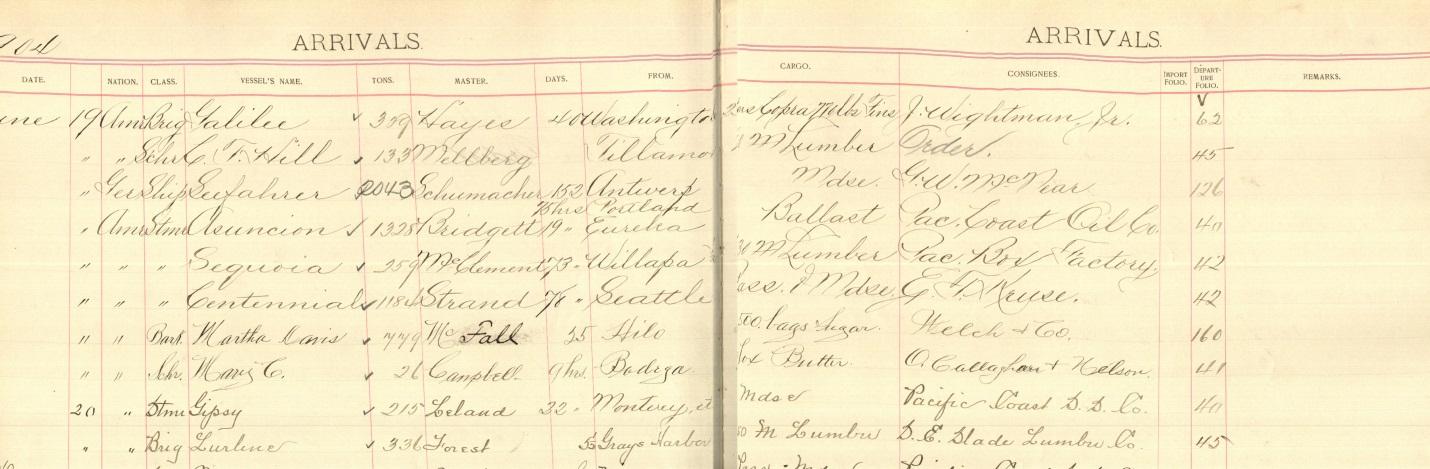
As I said, the Marine Exchange documented every vessel that came in or out of the bay. Our collection (HDC 559) includes:  12 Ledgers, scrapbooks of marine disasters, mishaps, and total losses, 102 Ledgers vessel arrivals/departures, indexed and a card index to arrivals by vessel name. Some of the collection is available on microfilm. The time span for the records is roughly 1886- 1982 for arrivals and departures and 1854-1962 for disasters, mishaps and total losses.  Here’s an example from Arrivals vol. 1 1904-1906. Note the first entry is the Mathew Turner  brig, the Galilee carrying a load of copra.


The ledger is so large it’s difficult to scan the entire page, but the information contained includes, date of arrival, nation, class name of vessel, tonnage, master, days from last port, cargo, consignees, import folio and departure folio and finally any remarks.  This is a heck of a lot of information.  There is no passenger information though. I REPEAT no passenger information (that’s for the intrepid genealogist who is already picking up the phone to call and see if their relative is listed- they’re not).

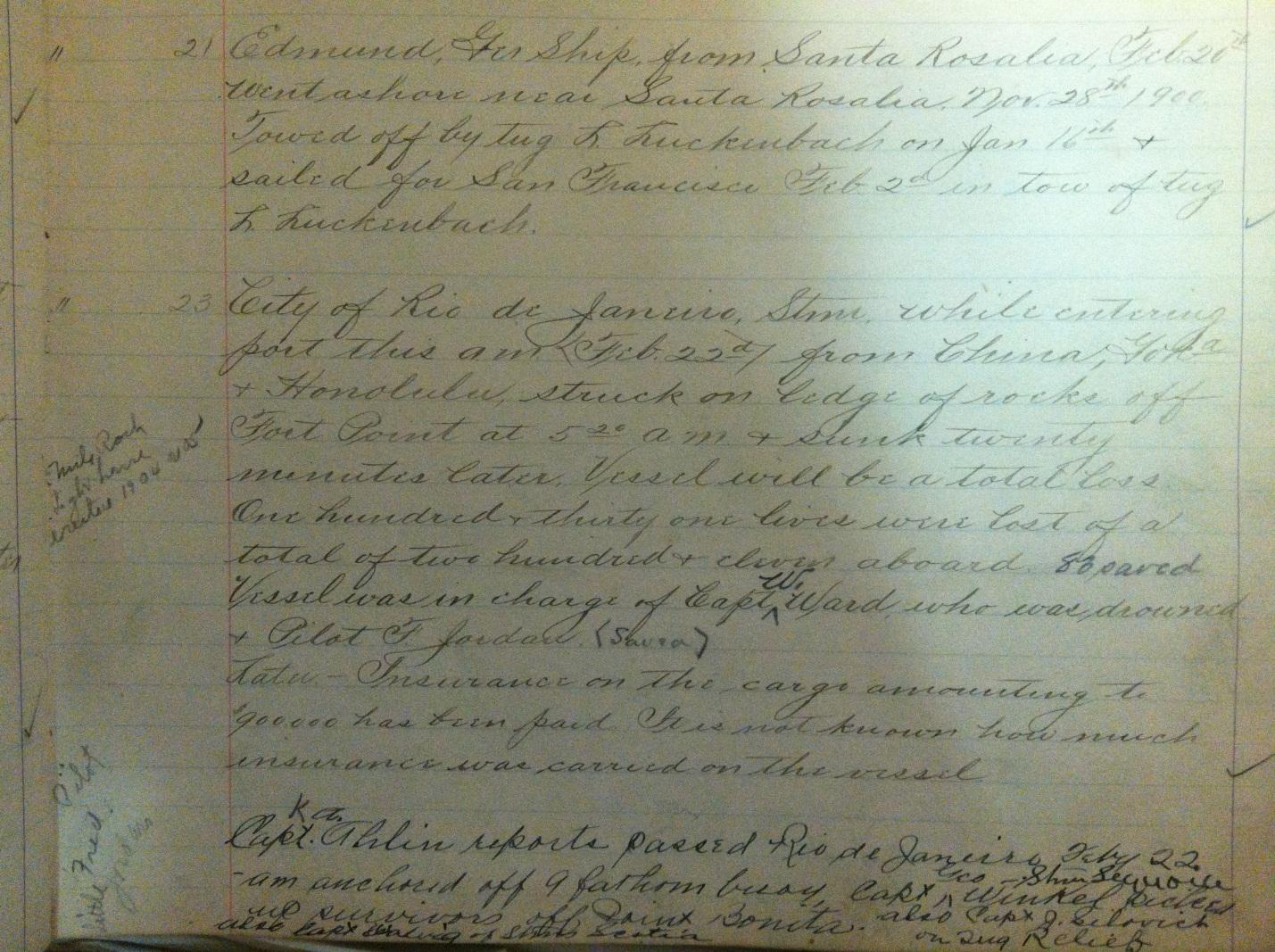
The Disaster and Mishaps and Total Losses ledgers are similar. Arranged by date, they list occurrences of cargos burned, masts snapped and crews lost with no traces to be found.  Some are detailed and seem to be retelling of Captains accounts, others are just a line or two.  Below is the entry from the Disaster log vol. 1 1900-1906 for the wreck of the City of Rio de Janeiro, a Pacific Mail steamer which hit a reef in San Francisco Bay.  131 people died. 


There is something for everyone in these records. It is my hope to have them all scanned and made available for researchers the world over.  Until then though, come to the library to see these unique records for yourself. 

The Marine Exchange Records (HDC 559 SAFR 18592) can be accessed in person by appointment. Some of the collection is available on microfilm and will be substituted for original material at the discretion of Collections Staff.  Please contact gina_bardi@nps.gov or call 415/561-7033. Scans or photocopies can be made as well at the discretion of the Collections Staff. Please see our Duplication Services for information on fees.

Tuesday, February 5, 2013

Holiday hours

The Library will be closed on Monday, February 18 in observance of Washington's Birthday.  We will be resuming normal service on Tuesday, February 19.

New Library Extension Chrome plugin for Keys

(by Heather Hernandez, Technical Services Librarian)

We are delighted to announce that in addition to the free LibX plugin for Firefox and Chrome, a free Library Extension plugin for Chrome is now available for Keys Catalog users.

The Library Extension plugin is similar to LibX, but it only works with Amazon, and is only available for Chrome.  Like LibX, it will let you click over to the Keys Catalog record for an item whenever it detects an item on Amazon that is also in the Keys Catalog--it does this through a box that appears in the Amazon display:

Screenshot of Demon of the Waters on Amazon with plugin added

If you click "Reserve your copy," then you will be taken to the Keys Catalog record for this item.

To install the plugin, go to LibraryExtension.com and follow the installation instructions.  You will need to configure it to work with Keys by looking under "California" for "San Francisco Maritime National Historical Park."  There are many other libraries that work with Library Extension--be sure to check out the list.

To find a LibX plugin to work with another library, select "Search for an edition for my community" from the main LibX page.

Note to other Koha users (the software that powers the Keys Catalog):  to get Library Extension plugin support for your catalog, simply visit Library Extension's Contact Us page and include the required information for your Koha catalog set up to be included in the next batch of supported catalogs.

Tuesday, January 29, 2013

Digging for Gold at the Library: Shackleton

(by Gina Bardi, Reference Librarian)

Cover of George Butler's film, Endurance

There’s a quite a chill in the air. Or at least there is in the library. As the winds have turned I like to call "brisk," my thoughts to cozying up with a warm blanket, a hot toddy and a film about Ernest Shackleton. The library has two Shackleton films on DVD. Both are documentaries and go in depth describing Shackleton and crew's incredible hard to imagine two year odyssey in Antarctica. The photography is stunning, partly because expedition photographer Frank Hurley went through desperate measures to save his glass plates (We’ll talk about that in another post). So come on over to our mostly warm Library and watch some great films about Endurance--both the ship and the concept. Unfortunately, hot toddies aren't allowed in the library but you can have one when you get home--I'm sure Shackleton did!

Tuesday, January 22, 2013

Nothing sails like an old bird

(by Amy Croft, Archivist)


I learned quite a bit about yachts, sailing, and racing while processing the Jack Ehrhorn collection of Stone Boat Yard photographs (SAFR 23147, P05-081). The Stone Boat Yard was a San Francisco Bay Area boat building company that was located in Alameda, California, from 1971-2004. The business had three previous names, and has been in four other locations in the San Francisco Bay Area since it was established in the Hunter's Point area of San Francisco in 1853.

The Stone Boat Yard built many yachts throughout the years, including many One Design Class boats, which means that all are the same model or design. This allows the boats to be on an even playing field and there is no handicap in the race; the first boat to cross the finish line wins. This also puts more focus on the skills of the competitors in the races since all the boats are the same. Many different One Design Class boats were built at the various Stone Boat Yards including: R-Class, M-Class, Yankee Class, and Bird Class.

While processing this collection, one of the things that I enjoyed learning about is that you can tell the difference between One Design Class yachts by looking at the images and numbers on the sail (which corresponds to the hull number). For example, Bird Class boats have a picture of bird wings and the number of the boat (numbers do not repeat between boats of this class). In addition to being interesting, this information might help me identify some photographs in another collection that I process, if the yacht in the photograph is unidentified but the symbols and numbers on the sail are visible.

Cuckoo (built 1929; sloop: yacht: Bird Class, No. 16) underway, starboard broadside view, circa 1929 

The Bird Class was a San Francisco Bay type, developed in the early 1920s to handle local wind and water conditions. In 1919, the Pacific Inter-Club Yacht Association formed the "S" Class Syndicate, "a committee of representatives of all six Bay Area Yacht Clubs, to renew interest in yachting, racing, and inter-club competition. The Syndicate came back with historical questions: How about designing an affordable, swift, racing cruiser that can charge through the blustery, choppy conditions of the San Francisco Bay with the confidence of a freighter? A boat that can fly across the foam topped waves like, say, a bird?" (Norton)

"Members of the Pacific Inter-club Yachting Association (P.I.Y.A.), local shipwright J. Herbert Madden Sr., P.I.Y.A. Representative Clifford A. Smith, and Sausalito Naval Architect Fred Brewer drew up a rough sketch of the proposed sloop for members of the San Francisco Yacht Club. The drawing was then sent to well-known boat designer John Alden for review and drafting. The San Francisco contingent accepted his suggestion for increased ballast but declined other modifications. … John Alden design Number 157 was drafted up by associate Sam Crocker on September 1, 1921 and became the basis for the Bird Class, which still exists today." (Hook)

The first bird boat was built by Madden & Lewis in Sausalito in 1921 for Leon De Fremery, and was named OSPREY (which is a large fish-eating hawk). There are rumors that boat has an exciting history: it was reported in some local newspapers that in 1929 she was stolen from the moorings off of Sausalito by an escaped convict and her remains were found on the sand at Dillon's Beach near the entrance to Tomales Bay (Hook). However, other people say that Osprey just drifted off her moorings and was never stolen (Kays).

Osprey (yacht; Bird class), September 10, 1922

There were four Bird Class boats built at the W.F. Stone & Son Boat Yard in Oakland from 1928-1929: Puffin (built 1928; sloop: yacht: Bird Class No. 12), Cuckoo (built 1929; sloop: yacht: Bird Class No. 16), Robin (built 1929; sloop: yacht: Bird Class No. 18) and Polly (built 1929; sloop: yacht: Bird Class No. 19).

Polly (built 1929; sloop: yacht: Bird Class, No. 19) underway, starboard broadside view
 

24 Bird boats were built from 1921-1947 and many of these boats are still racing on the San Francisco Bay today (Registry). As of 2007, Birds can still be seen participating in the San Francisco Yacht Racing Association, the Wooden Boat Racing Association, and the SF Master Mariner Annual Regatta (Pierre Josephs, http://www.birdboat.com/). So keep an eye out for a Bird Boat the next time you see yachts racing on the San Francisco Bay!

Terry Norton nicely sums up the current state of Bird Boats by writing the following:
"...today's sailors stand symbolically side by side the members of the "S" Class Syndicate of 75 years ago to prove that the Bird Boat is a gol dern fine boat, in a gol dern fine sport. No gimmicks, no reef points, no broaching, no storm sails, no ding of the microwave—just pure sailing. Like grandpa's day. Where are the Bird Boats today? While Dad's Model T sits in storage, waiting for the next parade, and Grandfather's golf clubs, framed on green velvet years ago, hang over the fireplace? Why, they're out on San Francisco Bay every weekend, tacking across the westerly "breezes" of the Bay, proving that the Bird Association's motto, "Nothing sails like a Bird" needs amending. After seventy-five years of soaring, nothing sails like an old Bird."
In addition to the photographs of Bird Boats in the Jack Ehrhorn collection of Stone Boat Yard photographs, the San Francisco Maritime NHP also has many other photographs of Bird Boats sailing on the San Francisco Bay. So if you're interested in seeing more old birds, you should come in and check them out!

Sources:

Hook, Jane (1996). The Bird Boats. Retrieved August 14, 2012, from http://www.birdboat.com/Hook.htm.

Josephs, Pierre (n.d.). Home page for the website Birdboat.com. Retrieved August 14, 2012, from http://www.birdboat.com/.

Kays, Gunnar. Letter to the Editor. Latitude 38: November 1997. Retrieved August 14, 2012, from http://www.latitude38.com/letters/199711.htm.

Norton, Terry (circa 1996). 75 Years Of Soaring: The Story of the San Francisco Bird Boats. Retrieved August 14, 2012, from http://www.birdboat.com/Terry%20Norton.htm.

Registry of Bird Boats. Retrieved August 14, 2012, from http://www.birdboat.com/Registry.pdf.

Tooker, Richard H. (circa 1983). Front matter for the Walter A. Scott photographs finding aid, P83-019.